• PARTNER: PROTECT YOUR WATERS
  • Go To: THE FLIES OF YELLOWSTONE
  • Go To: YELLOWSTONE FISHING WEATHER
  • Go To: YELLOWSTONE FLY FISHING MAPS
  • Visit: Moldy Chum
  • Visit: The Horse's Mouth
  • Visit: Chi Wulff
  • Visit: Parks' Fly Shop
  • Showing posts sorted by relevance for query rock snot. Sort by date Show all posts
    Showing posts sorted by relevance for query rock snot. Sort by date Show all posts

    Wednesday, May 07, 2008

    Some News Briefs

    BLACKFOOT GETS SOME RELIEF
    Rock Snot At It Again
    vigilance quashes quaggas
    NPS Partners To Fight Invasive Species
    whirling away in colorado

    Blackfoot River_<span class=
    .. This week the Nature Conservancy added 4,682 acres to an easement adjacent to a 2,888 acre easement already protected in the Blackfoot River Drainage. The nearly 7,000 acre chunk of land is prime trout and wildlife habitat.
    .. According to Matthew Frank in the recent
    New West Article:
    "The land is in the foothills southwest of Lincoln abutting the Helena National Forest, and the easement, held by Missoula-based Five Valleys Land Trust, will limit development on three and a half miles of Blackfoot River frontage and more than fourteen miles of its tributaries. It's Five Valleys Land Trust's largest easement to date."

    .. This is a welcome bit of relief for one of the fastest growing areas in Montana. The effort to protect the resource is a combination of personal, private, organizational, and charitable concerns. This acquisition is part of an ongoing 89,000 acre effort in the area.
    ------
    .. Protect Your Waters notes that Rock Snot is becoming an ever-present concern for fishers, boaters, and the general public. They cite several news articles that have called attention to the problems created by this slimy organism.
    .. We've posted several blurbs about about the diatom Didymosphenia geminata -DIDYMO, for short, (Rock Snot, for the rest of us.)
    .. The Star Ledger, a New Jersey newspaper, has taken up the cry to inform anglers of the threat and the ways to combat Didymo.
    .. Branded a "stream killer," the diatom covers river and stream bottoms with its oozing mass and deprives plants and animals of the surfaces that they need to live.
    .. The Express Times, another New Jersey newspaper, has an interesting, (and somewhat gloomy,) article about the life cycle of Rock Snot. The rapid spread of the organism from the northern hemisphere to the southern hemisphere, and its adaptation to a wide range of water conditions and temperatures suggest that its natural history may be changing. Check it out HERE.
    .. In the Baltimore Sun is another note about Rock Snot threatening the Gunpowder River. Just last December we noted that the river was under assault by a local canoe club. Now the killer snot is a clear and present danger.
    .. The algae bloom was noted by concerned anglers and reported to the state DNR last week. The Baltimore Sun article carries a note about the DNR providing washing stations and posting the river.
    .. A second news brief by the CBS affiliate WJZ in Baltimore notes that the DNR is asking boaters to was their boats in a saline solution. Didymo can survive on a damp surface for two or more days.
    .. Big Bear Lake in California came within inches of having a Quagga Mussel invasion. Via Protect You Waters, comes news that the Quagga Mussel is on the move. Quick action and insight save a near infestation at the boat ramp according to an article on the Big Bear Grizzly.com web site. The Metropolitan Water District is launching an all out public information campaign and has attendants at the boat launch facilities on the lake.
    -------
    .. In Nevada, National Park Service officials have been given the go ahead to join with local organizations to do battle with the Quagga Mussel and other invasive species according to an article in the Las Vegas ReviewJournal.com.
    .. A bill passed by congress removes a legal obstacle that had prevented the federal agency from entering cooperative agreements with states, local governments, landowners and American Indian tribes to battle invaders that steal water and crowd native vegetation.
    .. This could open the way for additional resources in the fight against invasive species.
    -------
    .. The Parvin Lake Research Station in Colorado, (home of the Hofer strain of Rainbow Trout, brought back to the USA from Germany a few years ago,) is inviting anglers to become research assistants in their efforts to develop trout hybrids that are resistant to Whirling Disease.
    .. Many of the hybrids are larger than the native trout and can rapidly reach five pounds, (this includes the HO-HA hybrid being tested in Utah.)
    .. Various hybrid strains have been tagged with small coded wires placed in the fishes' noses. Anglers are asked to visit the research station, report their experience, and if they keep fish -- have them scanned for identification. You can read more about the project in the North Forty News & Fossil Creek Current.
    .. This research is is detailed in a pair of notes on the Whirling Disease Foundation web site ( #1 #2 .) The cooperation between Colorado, Montana, California, and Germany has produced some success by using fish that were originally exported from the Gunnison River to Germany in the 1800's.
    .. The best news is that there may be an immune, (not just resistant strain,) present in the current research populations. Via Protect Your Waters, we've just read a note in FlyFishingDish that suggest -- nay -- says so. The sad news is that many native trout species and subspecies will be lost in the rush to sprinkle these hybrids around for the joys of angling.
    .. The disappearance of any species is a blow to the ecosystem. The solution to the problem of whirling disease has the seeds of another problem that is just in its infancy.
    .. We don't know how to do it, but it's time we considered a legacy fish bank. Be it sperm, or eggs, both or neither we should be thinking about it. Tissue samples, live fish repositories, and other solutions to the infant problem have been proposed.
    .. Just as the Gunnison River trout went to Germany and came back with a resistance to whirling disease, so too to many of our native species may have hidden genetic talents and predispositions that are yet to be discovered. We need to think about preserving them for the next plague. What ever it may be.


    photo courtesy Whirling Disease Foundation
    ------

    Saturday, September 29, 2007

    DAMNITALL !

    ROCK SNOT - ROCK SNOT - ROCK SNOT
    DAMNITALL - ROCK SNOT
    It's Here !
    (brief fishing report too)
    .. Sometimes called Sea Snot,the diatom Didymosphenia geminata - DIDYMO, for short, has been documented in the Snake River Drainage just south of Yellowstone National Park. We've posted several notes about this threat to Yellowstone Waters over the past year.
    .. This is a threat to the rivers and fishing in Yellowstone National Park and it is immanent! The latest report of the deadly goo comes from the USGS after they discovered it in Lake Creek near the Moose-Wilson Road bridge, and notified Grand Teton National Park last week.
    .. According to a story in the Jackson Hole Daily, (jhnews and guide.com,) Lexey Wauters, executive director of The Snake River Fund has stated that Didymo has the potential to “really decimate a watershed.”
    .. Research in New Zealand has provided promising results for the battle against Didymo; these have been reported by Protect Your Waters. We posted an extensive note about the possibilities for containment in February of this year.
    .. Max Bothwell, of Environment Canada, broadcast a segment on the radio show Quirks & Quarks in March of this year - (Listen to it here, open it in a new tab and listen to it in the background.)
    .. The Didymo organism can alter the food chain by covering the river bed with a slimy mat that kills the benthic invertebrates that trout eat. The best research suggests that fly fishers are the major culprits in the spread of this menace. The mechanism is felt-soled-waders that can carry unique genomes of indigenous variants of Didymo to new environments thus allowing the diatom to behave as an invasive species, rather than an endemic species.
    .. Clean and dry waders are a necessary tool in the battle to prevent the spread of this fresh water organism. Check out the non-felt wader boots at the Trout Underground.
    (Click on the images below for a better view.)

    . . . . . . . . . . . . .


    .. On a lighter note, our Friday biscuits and gravy breakfasts are mightily enhanced by the good folks over at The Horse's Mouth.
    .. We heartily endorse their sentiment HOORAY, IT'S FRIDAY !
    .. And, by the way, the Fish on Fridays post is just as spectacular as the Weekend Wahine. All the old grunts at the breakfast table are eagerly anticipating this winter's posts as hungrily as we look forward to the next shipment of Viagra to this remote location.
    .. Speaking of Viagra, have you seen the Obscene Bangers at Get Outdoors? Ugh! A Slaw Dawg it ain't!
    .. Straight from Thee Ass Hooked Whitey comes a video so full of giggles that we fell off the bar stool. This is not just another flying carp piece - it's too good to pass up.
    .. On the sidebar we've added the link to Yellowstone Wilderness Outfitters. And, like Yellowstone Mountain Guides they are truly expert guides, outfitters, and most importantly fishers. These folks are the backcountry pioneers and experts of Yellowstone. If you would like to catch a trout as it swims over the continental divide, check out the animated Thorofare Map. The water's low in the backcountry too - but the fishing pressure is ever-so-slight.
    .. A note at Yellowstone Park News led us to read about the low water and melting glaciers in Glacier National Park. It seems that many of the rivers, containing glacial melt water that feed the lakes, are not getting to the lakes. This is definitely hard on Montana's very rare Bull Trout. The Missoulian carries the story and the situation sounds dire at best.
    . . . . . . . . . . . . .
    .. There are quite a few lake fish moving into the Madison River. They are moving slowly, (though we anticipate that this spate of cool weather will speed them up,) and are stalled at the park line. Although a few fish have made it upstream, the large schools of fish have podded-up between the estuary and Baker's Hole. You'll need a Montana fishing license if you fish outside of the park.
    .. The neighbors are now using a variety of flies for these recalcitrant migrants. The old favorite Hornberg is making its fall appearance. It is fished both wet and dry and is on the end of many a fly line. Use the bigger sizes for the wet version, (4 - 8,) and the smaller sizes for the dry, (10-14.) The wet is fished as a streamer on the drift with a full swing to a tight line at the end. Some neighbors can strip this fly faster than the current - if you can do it this, it is a deadly technique for the deep holes.
    .. The Yellowstone Spruce Fly and the Yellowstone Winter Grub are making their appearance along side the Dark Spruce Fly and the dark olive green Woolly Bugger.
    .. A local cult has sprung up around the Hairwing Dark Spruce Fly. You can find it at the Thread & Feathers section of Montanawild Gallery. It's a fairly old rendition of the fly that has been experiencing a renewed vitality among the neighbors.
    .. Soft hackle flies are doing their share of the work as well. The visitors are buying what the fly shops sell and are doing all right, the neighbors are sticking with the Royal Prince Soft Hackle and doing a bit better. Although the run is on, it should get better very soon. It should also get more crowded - and it's already full of fishers in the traditional places. Rumor and tradition do a lot to mitigate against the understanding that the river changes annually and with its flows. Try some new water, Try a different fly - you'll probably be pleasantly surprised.
    .. Try this little beetle fly in the slow deep water of undercut banks. Toss it into a foam line and let it float lazily along its merry way - hold on tight!
    . . . . . . . . . .
    .. We're headed to the park to see if the log jam has broken. There are rumors of big fish as high up as the falls on the Gibbon River - we'll let you know.

    Monday, December 08, 2008

    Of Stoats, Rock Snot, & Blue Ducks

    NEW ZEALAND WHIO
    TWO-TIMED
    Invasive Species x 2
    .. From Protect Your Waters comes a note about Didymo and it's spread in New Zealand. The diatom has been discovered in the world fly fishing destination-river Karamea, in Kahurangi National Park.
    .. The saga of threats to the Blue Duck is an example of "unintended consequences."
    .. Rabbits, introduced to New Zealand became a pest. The stoat, (ermine,) was introduced to control the rabbits. The ermines found native ducks easier to catch and eat.
    .. The native Whio, (Blue Duck,) is endangered and now being threatened by Rock Snot, (Didymosphenia geminata,) in addition to the stoats.
    .. This double threat from invasive species is a classic example of the exponential threats facing native species around the world.
    .. The Scottish Author knew it well:

    Oh what tangled webs we weave
    When first we practice to deceive
    .

    .. It's not good to fool with Mother Nature.
    .. The same kind of threats face many species in Yellowstone National Park: fish and others. Our "deception" is improving all the time.
    .. Early on, Victorians, Sportsmen, and Yellowstone Park Managers introduced exotic fish into the rivers of the park. The fish brought fishers. Fishers brought other invasive species.
    .. Now Yellowstone's native Cutthroat Trout are disappearing through predation and interbreeding. Rainbow Trout, Brown Trout, and Lake Trout are the primary culprits at present. The New Zealand mud snails, Didymo, and other world travelers are threats looming on the near horizon.
    .. Fishing has grown, (though not recently,) to invade all fishable waters. It is a pastime that unthinkingly - or innocently - believes that it is about the fish.
    .. Rivers, lakes, ponds, oceans, and the other waters that contain the fish are usually secondary in the thinking process of fishers. The ecology of the fish and its environs are way down the list of concerns and conversation. This has got to change if fishing is to continue in our national parks.
    .. Rock Snot is at the south entrance to Yellowstone National Park. The threat is real and the diatom will probably be in the rivers within the park in the next year or two. It may be there now - unnoticed by fishers and managers alike.
    .. For information about the hybrids in Montana's fishery visit: Trout Conservancy Of Montana. For information about Rock Snot just use your search engine.

    Friday, February 16, 2007

    Yellowstone, Didymo & Eco-Toxicology


    CAN WE WIN ONE?
    Answers Coming Soon - We Hope

    .. The diatom Didymosphenia geminata has been spreading slime and destruction in New Zealand waters at a rapid rate. It is also gaining an ever-widening presence in North America. The common name is ROCK SNOT, and it fits.
    .. After spending $12,000,000 on research, New Zealand is conducting it's first field tests with an eradication procedure that may just help conquer this slimy devil.
    .. The Southland Times from New Zealand has a story today about the field research that led to this trial.
    .. Eight study sites on the Princhester Stream will be treated with a chelated-copper compound called Gemex. This poison is the best, (so far,) in the battle. Monitoring of the results will also include observing effects on not only didymo but native algae, water invertebrates and fish.
    .. The research is being conducted by Dr. Sue Clearwater, an eco-toxicologist for the National Institute of Water and Atmospheric Research (Niwa). Results should be available soon.
    .. Rock Snot is one of the Five Invasive Threats currently known to threaten Yellowstone National Park. We have mentioned Rock Snot in previous posts and now look to this research in New Zealand for hope in being able to win one small battle.
    ________________
    .. Stop Hitchhikers has just posted news about other invasive species. There is a possible $9,000,000 to control Asian Carp, an increase in VHS in the Great Lakes, and the concern about over control of non-native species.

    Sunday, October 15, 2006

    Yellowstone Invaders Battled

    BECOME PART OF THE SOLUTION
    What's The Problem ?
    does it really matter ?
    IT WON'T HAPPEN IN MY NEIGHBORHOOD !
    .. The Greater Yellowstone Ecosystem , and particularly the blue-ribbon trout streams like the Madison, the Snake and Yellowstone River are under considerable pressure from the aquatic invasive species issue with threats like Whirling Disease, New Zealand Mud Snails and now Didymo.
    .. However, as challenging and serious as these environmental stressors are, they have brought about a new response. Through the leadership of the American Fly Fishing Trade Association, the Protect Your Waters Campaign, and the ANS Task Force, intense business competitors like Patagonia and Simms have come to the table to work with leading retailers like Jack Dennis, state fish and wildlife agencies from Wyoming, Idaho and Montana and federal agencies such as the U.S. Fish and Wildlife Service, the U.S. Forest Service and the National Park Service.
    .. This is in response to combating aquatic invasive species threats. Last weekend, a workshop was held in Jackson, WY to help all of these organizations move in the same direction to pull resources and expertise to mount a unified response.
    .. This alliance has produced a working group of concerned organizations, businesses, governmental agencies, and individuals who are willing to join the fight. A two-pronged strategy has been developed for our area.
    ..We've noted the efforts of the ANS TASK FORCE continuously, and believe that all fisher folk should be informed by the threats imposed by the invasive species. The banner at the top of the page will take you to the public awareness campaign web site. The outline proceedings of the conference can be found HERE (PDF.)
    .. We are acutely aware of the problem. We have Whirling Disease, New Zealand Mud Snails, and zebra mussels are marching up the Missouri. Rock Snot is about invade, and the Lake Trout have badly impacted our native Cutthroat.
    The need to be informed is the first step in the battle. Join the campaign and spread the word. The mistaken idea that it won't happen in your favorite stream will end up ruining your fishing.

    .. California, Montana, Washington, Oregon, Wyoming, Idaho, Utah, Colorado, New Mexico, and Nevada all have rapidly spreading whirling disease in their fish populations. This insidious disease attacks the fry of the year and produces crooked fish - easily preyed upon. A European disease, it affects native species while allowing the invasive Brown Trout to escape with little or no harm. It is coming to a stream in your backyard.
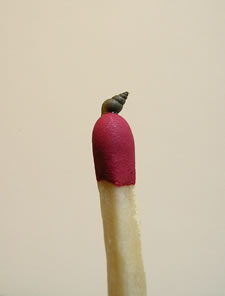
    .. New Zealand Mud Snails are small insidious invaders that out compete native forms, multiply rapidly, provide minimal nutritive value to trout, and reduce trout food by devouring native vegetation and the bugs that live there.
    .. The snails can live out of the water for long periods of time, reproduce asexually, and are being carried by fly fishers along our precious trout waters. They are so small that defensive measures are tedious and must be carried out deliberately. They are coming to a stream in your front yard.
    .. Rock Snot ; didymo algae (Didymospheniageminata), is moving all around us. It coats and clings to rocks and other substantial substrate. It reduces the living areas for surface clinging forms like Caddis Flies & May Flies. If you don't think that this will impact your fishing you need some leaky waders. Rock snot is probably already in your neighborhood and harming your fishing.
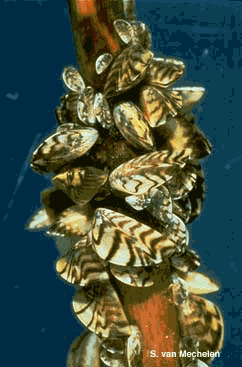
    .. Zebra Mussels have persistently marched from bilge water in the Great Lakes to most of the upper Mississippi and Missouri River systems. These tenacious shellfish will grow anywhere and can clog pipes, foul chains, plug water inlets, clog sewage discharge, and multiply at a rate that makes mice & rabbits seem stodgy.
    .. Invasive fish species are one of the most damaging forms of ecological threat. The legacy of uninformed and indiscriminate 19th century aquaculture is with us today. It is a continuing and growing threat to native species. This is a thorny problem that is both cultural and ecological.
    .. The Lake Trout in Yellowstone Lake has greatly reduced the native population of Cutthroats. Invasive Brown Trout, Brook Trout, & Rainbow Trout have reduced the numbers of native species in the Madison River, Slough Creek, the Gallatin River, The Gibbon River, and other streams of the area. Both fly fishers and feather merchants see fish as a catchable resource and are loath to decry the invaders. This cultural perspective asks us to decide if we value native fish, in their native setting - or not.
    .. This condition is already in your neighborhood and requires all of us to confront a very basic question: are all fish in all waters of equal value? Fly fishers shy away from this question because it jeopardizes their sport. Feather merchants shy away from the question because it jeopardizes their business. The general non-fishing population could care less - for the moment.

    .. This question has been answered in a surprising way by Ronald Bailey in the ReasonOnlie piece - The Exotic Species War. It has also been obliquely addressed by our neighbor Skyblu at Invasive Species. If this condition is viewed as a war it may have no satisfactory outcome. This could be the Viet Nam or Iraq of fly fishing. The eventual invasion of all suitable waters by flying carp or grass carp, or killer Brown Trout. It bears thinking about both in terms of cultural values and biodiversity.
    __________________
    FOOD FOR THOUGHT
    Salmonid Parasites | What Is Whirling Disease? | Whirling Disease Movies | More Whirling Disease Movies | Invasive Species Weblog | New Zealand Department of Conservation | New Zealand Bio Security | Manitoba Water Stewardship | California Water Resources | Fishing In Yellowstone | Invasive Threats to Yellowstone Fisheries | Effects of Lake Trout on Native Cutthroat in Yellowstone Lake | Protect Your Waters | California Mud Snail Defenses | California's Noxious Algae | Effects of Invasive Fish in California | Invasive Fish Threaten Oregon Salmon | New Zealand Mud Snails on Deschutes | Eurasian Milfoil & New Zealand Mud Snails in Washington | Panther Creek Idaho Destroyed by Invasive Fish | Idaho Invasive Species Teaching Position | Brown Trout Causing Extinction of Native Arizona & Colorado Fish | Nutrient Distribution Altered by Invasive Species | Amur Gobi In Columbia River | Atlantic Salmon Threaten Alaska Fishery | More Atlantic Salmon in Alaska |
    _____________________________

    Saturday, December 29, 2007

    Rock Snot In The News Again

    NPR JUMPS ON THE BANDWAGON
    This Is A Good Thing
    .. The NPR website just published an article about the diatom Didymosphenia geminata -DIDYMO, for short, (Rock Snot, for the rest of us.)
    .. Now that the little slimy nuisance has made it to the Delaware River, the problem is less a 'Western Problem' and is making inroads into the popular press. This is a good thing.
    .. NPR even went to the trouble of building an interactive graphic of five of the most loathed invasive species. This too, is good. Now we just need to hear more about the continuing threats to our fisheries from the industry mavens, bloggers, and sports writers.
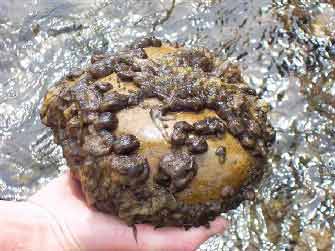
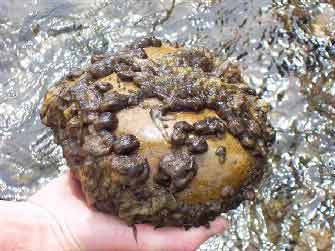
    .. The insidious thing about invasive species is that they live mostly out of sight and do their damage away from the photographer's lens. Photographs of Rock Snot are not nearly as sexy as an old fart holding a fish and so they are not published.
    .. Didymosphenia geminata has gone from an isolated western Canadian phenomenon to a North American scourge in just a couple of decades. It has mutated into several forms that bloom and recede or bloom and cover river bottoms from bank to bank. Currently it is creeping into Yellowstone along the Snake River near Jackson, Wyoming.
    .. This little critter has become a world traveler and is found from Mississippi to New Zealand and from California to Connecticut. Visit Protect Your Waters and the Invasive Species Weblog for information about these things.