• PARTNER: PROTECT YOUR WATERS
  • Go To: THE FLIES OF YELLOWSTONE
  • Go To: YELLOWSTONE FISHING WEATHER
  • Go To: YELLOWSTONE FLY FISHING MAPS
  • Visit: Moldy Chum
  • Visit: The Horse's Mouth
  • Visit: Chi Wulff
  • Visit: Parks' Fly Shop
  • Showing posts sorted by relevance for query native fish conservation. Sort by date Show all posts
    Showing posts sorted by relevance for query native fish conservation. Sort by date Show all posts

    Tuesday, March 13, 2012

    Native Fish Get Boost

    $1,000,000 = $2,000,000
    Grant Matched By NPS
    just a start
    SEE THE LAKE TROUT?  SEE THE CUTTHROAT?  YUM, YUM !!
    -------
    ..The Yellowstone Park NATIVE FISH CONSERVATION PROGRAM has been given a boost by the finalization of the $1,000,000 grant from the Yellowstone Park Foundation.
    .. Last December we noted that Yellowstone Park was embarking on a comprehensive program to protect and preserve native fish stocks. That program is now underway with the infusion of funds and the implementation of the plan.
    .. The recognition that the native fish and their abundance and distribution and behavior constitute a vital link in the ecology of the park has led to this action. As a food source for grizzly bears, birds, coyotes, otters, and other animals the native species are vital to the health of the ecosystem.
    .. This effort is designed to address all aspects of the concerns about the dwindling populations of native fish and will guide management for the next two decades and beyond.
    .. A major concern, of course, is the impact of Lake Trout on the native cutthroat population. Efforts to ameliorate this impact will include stepped-up gill netting efforts, research, and plans to create a resiliency in the native fish population.
    .. It will probably take six years to accomplish the major goals of the project. During this time future strategies and management plans will also be developed to insure that the native fish population can be successfully managed in the face of:
    ** Predation by non-native fish such as Lake Trout and Brown Trout,
    ** Hybridization with non native Rainbow Trout,
    ** Drought, climate change and fishing pressure.
    .. The top priority of this action is to decrease the number of Lake Trout in Yellowstone Lake.
    .. Additionally the project aims to:
    + Restore Yellowstone cutthroat trout to waters within the northern portion of the park;
    + Develop a westslope cutthroat trout brood source;
    + Continue long-term restoration efforts of westslope cutthroat trout; and
    + Begin to restore Arctic grayling within the Gallatin and Madison drainages.
    .. Information Resources:
    -- Yellowstone Park Foundation Announcement,
    -- Yellowstone Park Information Document (PDF),
    -- FONSI Native Fish Conservation Plan (PDF),
    -- Native Fish Conservation Plan EA (PDF),
    -- Native Fish Conservation Plan EA;  Chapters 1-5 (PDF),
    -- Native Fish Conservation Plan EA; Appendices A-F (PDF),
    -- Native Fish Conservation Plan EA; Appendix G (PDF).
    -------

    Thursday, December 23, 2010

    Short Fuse, Comments Needed

    20 YEAR EFFORT
    Comment Now
    no whiners

    -------
    .. The NATIVE FISH CONSERVATION PLAN is designed as a major effort to respond to the diminished stocks of native fish in Yellowstone National Park.
    .. The Environmental Assessment is now open for public comment.
    .. Mark your calendars; only two public meetings are scheduled:
    * Bozeman, Montana: January 5th from 6:00 to 8:00 p.m., at the Comfort Inn, 1 370 North 7th Avenue
    * Cody, Wyoming: January 6th from 6:00 to 8:00 p.m., at the Holiday Inn, 1701 Sheridan Avenue.
    .. Written comments may be submitted through the project web site, in person, by mail, or at either of the scheduled public meetings. Comments will not be accepted by phone, fax, or e-mail. All public comments must be received or postmarked by midnight, January 31, 2011.
    ..  Here are the important Links:
    ==> Project Home Page,
    ==> Project Plan Process,
    ==> Meeting Notices,
    ==> Project Links,
    ==> Document List,
    ==> Comment Form.
    -------
    .. The scoping meeting in West Yellowstone last April was poorly attended. No feather merchants were present, one local guide was present, and a handful of concerned fishers attended.
    .. Input by these few interested parties helped shape the current document that is now open for review.
    .. The EA addresses Lake Trout in Yellowstone Lake, other invasive species throughout the rivers in the park, the effects of climate change on native species, and disease.
    .. Conservation efforts addressed include: increased gill netting in Yellowstone Lake, establishing barriers and weirs, removing non native species, restoring native populations, and a host of other actions including poisoning fish populations.
    .. The key concept is conservation. The actions taken to implement this can be extensive, varied, and vast.
    .. It's important that input at this time be concise, reasoned and rational. It will help steer the project and will certainly affect the fishscape of the future.
    .. Please understand that, at base, this addresses the question of "What Is The Purpose Of Yellowstone National Park." Several guides have remarked that it does no good to replace one trout with another. They are just concerned with catching any fish.
    .. Many guides and fishers of the park will be voicing opinions that catching fish, (the more - the better,) is what the park should provide.
    .. There are others that feel it's important to remove all invasive species such as Rainbow Trout, Brown Trout and Brook Trout to foster the recovery of native Cutthroat Trout & Grayling(?).
    .. Many feather merchants feel that the role of Yellowstone National Park is to provide fishing opportunities for recreational fishing, (and an economic base for their enterprise.)
    .. Some conservationists believe that the only way to enable preservation of native fish is to "restore" the park to "natural" conditions, including removal all planted stocks of fish, (which is a large segment of the current fishable populations.)
    .. Definition of terms and concepts will be argued and explored at the public meetings and in the submitted comments. Many oxen could be gored by this project.
    .. The subtext of comments will be interesting to observe, as will the rationale behind the proposed actions in those comments.
    .. Some fishers of Yellowstone have opined that since Brown Trout have been in the rivers for over 100 years that they are "native."
    .. Does that make Lake Trout native if they survive another 70 years?
    .. In another 100 years what will the descendants of those fishers say about Rock Snot, New Zealand Mud Snails, and other yet unforeseen invasive species?
    .. As the waters warm will we see Yellowstone become a trophy fishery for Carp and Chubs and Largemouth Bass?
    .. What will happen if some fool decides to dump Northern Pike or Muskellunge or Lake Trout in Hebgen Reservoir, right at Yellowstone's door?
    .. Your input is necessary for the decision making process. We're talking about the future and how history will view the legacy that we leave.
    .. Make no mistake about it, this is a significant project. It will last for 20 years, (1/5 of the next 100 years.) It will significantly affect the definition of Yellowstone National Park and it's role in species conservation and recovery.
    .. It will also determine who fishes where and for what in the park. It is an historic effort that demands you input and your concern for how Yellowstone is defined: a fun and profitable fishery for visitors seeking "non-native," invasive trout or a refuge for indigenous species - or both.
    -------
    .

    Wednesday, August 28, 2013

    Sorry We Missed This

    NPS PRESS RELEASE


    Date: August 19, 2013

    National Park Service
    U.S. Department of the Interior

    Yellowstone National Park
    P.O. Box 168
    Yellowstone National Park, WY 82190

    FOR IMMEDIATE RELEASE
    August 19, 2013 13-066

    Al Nash or Dan Hottle
    (307) 344-2015
    YELL_Public_Affairs@nps.gov

    ------------------------------------------------------------------
    YELLOWSTONE NATIONAL PARK NEWS RELEASE
    ------------------------------------------------------------------

    Yellowstone Begins Native Fish Restoration in Grayling Creek

    Yellowstone is taking another step forward this week in efforts to restore native westslope cutthroat trout and Arctic grayling in park waters.

    Grayling Creek and its tributaries are located north of West Yellowstone in the Madison River drainage.

    Decades ago, the streams were invaded by non-native brown and rainbow trout. Their presence has contributed to a decline in native cutthroat trout in park lakes, rivers and streams.

    This week an interagency team of biologists will introduce a fish toxin into the streams to remove the non-native trout as part of Yellowstone's Native Fish Conservation Plan and Environmental Assessment, which was approved in May 2011. Only waters within Yellowstone National Park will be treated. The project will not impact downstream reaches.

    While the chemical Rotenone will be introduced in small quantities, visitors are advised not to swim in or drink from the streams now through August 30. Warning signs will be posted at all treated areas.

    This year's treatment is the first in a series that is expected to continue over the next two to three years. Treatments will be conducted until nonnative trout have been completely removed from the streams. The park will then reintroduce genetically pure native Arctic grayling and westslope cutthroat trout to the streams. The long term plan is not only to support native species restoration, but also for these streams to provide a brood stock population for future restoration efforts in the region.

    More information on the park's Native Fish Conservation Plan can be found online at http://parkplanning.nps.gov/projectHome.cfm?projectID=30504.

    - www.nps.gov/yell -

    -------

    GRAYLING CREEK  =  SOON TO BE FISHLESS

    Friday, April 28, 2006

    YELLOWSTONE FLY FISHING MAP RELEASED:

    NEW MANAGEMENT AREAS DEFINED,
    Catch & Keep Non-Natives,
    Barbless Rules Inacted.


    <-- NPS Map


    The new areas are:
    ". . aimed at enhancing the involvement of the angling community in the park’s effort to conserve native species by reducing competition, predation, and hybridization by non-natives introduced to park waters decades ago,” said Dr. Todd Koel, the park’s lead fisheries biologist.


    Regulations are available here:
    http://www.nps.gov/yell/planvisit/todo/fishing/index.htm

    The whole press release is posted here:
    http://www.nps.gov/yell/press/0621.htm

    We've included it here too:
    Yellowstone National Park News Release
    INFORMATION FOR THE MEDIA
    CONTACT: Nash or Vallie
    FOR IMMEDIATE RELEASE
    (307) 344-2010 or 344-2012
    April 19 , 2006

    06-21
    Yellowstone National Park Changes Fishing RegulationsTo Enhance Protection Of Native Species
    Anglers need to be aware of new fishing regulations that take effect this year in Yellowstone National Park.
    The new, easier to understand regulations are designed to enhance protection of native species while protecting the park’s world-class angling opportunities. Anglers expressed broad support for the changes when proposed during a lengthy public comment period last year.
    For the first time, anglers will be required to use barbless hooks when fishing in Yellowstone waters. This change is designed to reduce injury to all fish species.
    There will be just two different fish management areas to simplify size and possession limits of native and non-native fish.
    In the Native Trout Conservation Area, anglers must catch and release all native species, but can keep up to five non-native fish of any size per day. All lake trout in Yellowstone Lake must be killed. There is no possession limit on lake trout caught in Heart Lake.
    In the Wild Trout Enhancement Area, anglers will again be required to catch and release all native species. Within this area, brown and rainbow trout are also fully protected by catch and release regulations. Anglers may keep up to 5 brook or lake trout per day in this area. There are some exceptions to these rules in Lewis and Shoshone Lakes and associated streams above the Lewis River and Lewis Falls areas.
    “These changes are aimed at enhancing the involvement of the angling community in the park’s effort to conserve native species by reducing competition, predation, and hybridization by non-natives introduced to park waters decades ago,” said Dr. Todd Koel, the park’s lead fisheries biologist. “We’re asking anglers to assist us in our conservation efforts by harvesting non-native fishes from streams and lakes where they coexist with our native cutthroat trout and Arctic grayling. In these waters there is no question that the introduced, non-native species are continuing to do serious harm.”
    This year the season opens on Saturday, May 27, and runs through Sunday, November 5. Fishing permits are available at all ranger stations, visitor centers, and Yellowstone General Stores. Permits for those 16 and older are $15 for 3 days, $20 for 7 days, and $35 for an annual permit. Younger anglers must fish with an adult who holds a valid permit or obtain a free fishing permit. The fees generated from fishing permits stay in the park and go toward fisheries protection and management.
    Try this for relaxation:


    Sunday, October 15, 2006

    Yellowstone Invaders Battled

    BECOME PART OF THE SOLUTION
    What's The Problem ?
    does it really matter ?
    IT WON'T HAPPEN IN MY NEIGHBORHOOD !
    .. The Greater Yellowstone Ecosystem , and particularly the blue-ribbon trout streams like the Madison, the Snake and Yellowstone River are under considerable pressure from the aquatic invasive species issue with threats like Whirling Disease, New Zealand Mud Snails and now Didymo.
    .. However, as challenging and serious as these environmental stressors are, they have brought about a new response. Through the leadership of the American Fly Fishing Trade Association, the Protect Your Waters Campaign, and the ANS Task Force, intense business competitors like Patagonia and Simms have come to the table to work with leading retailers like Jack Dennis, state fish and wildlife agencies from Wyoming, Idaho and Montana and federal agencies such as the U.S. Fish and Wildlife Service, the U.S. Forest Service and the National Park Service.
    .. This is in response to combating aquatic invasive species threats. Last weekend, a workshop was held in Jackson, WY to help all of these organizations move in the same direction to pull resources and expertise to mount a unified response.
    .. This alliance has produced a working group of concerned organizations, businesses, governmental agencies, and individuals who are willing to join the fight. A two-pronged strategy has been developed for our area.
    ..We've noted the efforts of the ANS TASK FORCE continuously, and believe that all fisher folk should be informed by the threats imposed by the invasive species. The banner at the top of the page will take you to the public awareness campaign web site. The outline proceedings of the conference can be found HERE (PDF.)
    .. We are acutely aware of the problem. We have Whirling Disease, New Zealand Mud Snails, and zebra mussels are marching up the Missouri. Rock Snot is about invade, and the Lake Trout have badly impacted our native Cutthroat.
    The need to be informed is the first step in the battle. Join the campaign and spread the word. The mistaken idea that it won't happen in your favorite stream will end up ruining your fishing.

    .. California, Montana, Washington, Oregon, Wyoming, Idaho, Utah, Colorado, New Mexico, and Nevada all have rapidly spreading whirling disease in their fish populations. This insidious disease attacks the fry of the year and produces crooked fish - easily preyed upon. A European disease, it affects native species while allowing the invasive Brown Trout to escape with little or no harm. It is coming to a stream in your backyard.
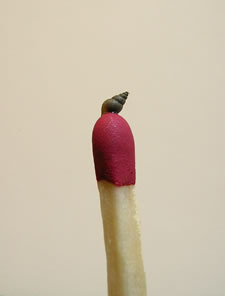
    .. New Zealand Mud Snails are small insidious invaders that out compete native forms, multiply rapidly, provide minimal nutritive value to trout, and reduce trout food by devouring native vegetation and the bugs that live there.
    .. The snails can live out of the water for long periods of time, reproduce asexually, and are being carried by fly fishers along our precious trout waters. They are so small that defensive measures are tedious and must be carried out deliberately. They are coming to a stream in your front yard.
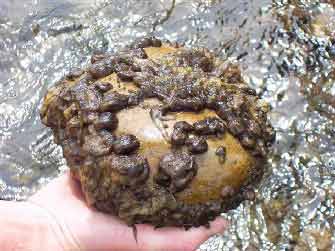
    .. Rock Snot ; didymo algae (Didymospheniageminata), is moving all around us. It coats and clings to rocks and other substantial substrate. It reduces the living areas for surface clinging forms like Caddis Flies & May Flies. If you don't think that this will impact your fishing you need some leaky waders. Rock snot is probably already in your neighborhood and harming your fishing.
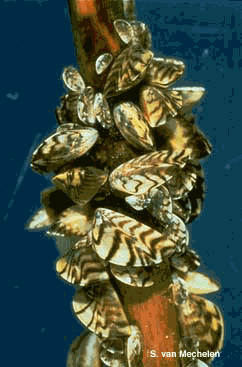
    .. Zebra Mussels have persistently marched from bilge water in the Great Lakes to most of the upper Mississippi and Missouri River systems. These tenacious shellfish will grow anywhere and can clog pipes, foul chains, plug water inlets, clog sewage discharge, and multiply at a rate that makes mice & rabbits seem stodgy.
    .. Invasive fish species are one of the most damaging forms of ecological threat. The legacy of uninformed and indiscriminate 19th century aquaculture is with us today. It is a continuing and growing threat to native species. This is a thorny problem that is both cultural and ecological.
    .. The Lake Trout in Yellowstone Lake has greatly reduced the native population of Cutthroats. Invasive Brown Trout, Brook Trout, & Rainbow Trout have reduced the numbers of native species in the Madison River, Slough Creek, the Gallatin River, The Gibbon River, and other streams of the area. Both fly fishers and feather merchants see fish as a catchable resource and are loath to decry the invaders. This cultural perspective asks us to decide if we value native fish, in their native setting - or not.
    .. This condition is already in your neighborhood and requires all of us to confront a very basic question: are all fish in all waters of equal value? Fly fishers shy away from this question because it jeopardizes their sport. Feather merchants shy away from the question because it jeopardizes their business. The general non-fishing population could care less - for the moment.

    .. This question has been answered in a surprising way by Ronald Bailey in the ReasonOnlie piece - The Exotic Species War. It has also been obliquely addressed by our neighbor Skyblu at Invasive Species. If this condition is viewed as a war it may have no satisfactory outcome. This could be the Viet Nam or Iraq of fly fishing. The eventual invasion of all suitable waters by flying carp or grass carp, or killer Brown Trout. It bears thinking about both in terms of cultural values and biodiversity.
    __________________
    FOOD FOR THOUGHT
    Salmonid Parasites | What Is Whirling Disease? | Whirling Disease Movies | More Whirling Disease Movies | Invasive Species Weblog | New Zealand Department of Conservation | New Zealand Bio Security | Manitoba Water Stewardship | California Water Resources | Fishing In Yellowstone | Invasive Threats to Yellowstone Fisheries | Effects of Lake Trout on Native Cutthroat in Yellowstone Lake | Protect Your Waters | California Mud Snail Defenses | California's Noxious Algae | Effects of Invasive Fish in California | Invasive Fish Threaten Oregon Salmon | New Zealand Mud Snails on Deschutes | Eurasian Milfoil & New Zealand Mud Snails in Washington | Panther Creek Idaho Destroyed by Invasive Fish | Idaho Invasive Species Teaching Position | Brown Trout Causing Extinction of Native Arizona & Colorado Fish | Nutrient Distribution Altered by Invasive Species | Amur Gobi In Columbia River | Atlantic Salmon Threaten Alaska Fishery | More Atlantic Salmon in Alaska |
    _____________________________

    Monday, August 28, 2006

    DEMYTOLOGIZING YELLOWSTONE

    mythology
    river reports
    Blogs Blogging

    YELLOWSTONE M
    YTH: "The fishing in Yellowstone is 100% catch and release." Not so! In fact, the managers of Yellowstone National Park are aware of the need to keep and kill fish. This places a burden of informed responsibility on the angler.
    .. However the catch and release ethic is so deeply ingrained in contemporary fly fishers that it has become an absolute truth for many, (Google shows about 8,340,000 references.)
    .. This is not necessarily good. The question of, "if, and/or when to release, and when to keep, (or kill,)" has been neglected by the fly fishing community - to it's detriment.
    .. As Practiced, (far'n fine, - don'tchaknow;) catch and release really means: Hook, Play to Exhaustion, Handle, Remove From Water, Squeeze Gut, Photograph, "Revive," Release.
    .. Values and perceptions cloud the issue to the point that rational discussion is often impossible. Yet, Yellowstone presents the conscientious angler with a laboratory for addressing the underlying values and perceptions of the catch and release ethic.
    .. Currently, Slough Creek meadows are in the early stages of hybridization of the native Cutthroat Trout population by invading Rainbow Trout. Yellowstone Park Regulations (pg. 10,) ask anglers to harvest Rainbow Trout to preserve the native wild population. Of course this requires the angler to know how to identify fish.
    ..Yet most anglers release all fish taken on Slough Creek. If this practice continues, the trout will all be hybrids far sooner than later. The question is one of value. Are native, resident, wild Cutthroat Trout worth preserving? Or, is catching -- then releasing any fish more important? Is your experience degraded by catching maimed fish?
    .. Lee Wulff is most often quoted in support of catch and release as an absolute ethic: "Game fish are too important to only catch once." This surely doesn't hold for the Lake Trout in Yellowstone Lake - or does it? How about the Brook Trout in Grebe Lake? How about the Brook Trout in the nursery fishery of Duck Creek? How about the Brown Trout in the Madison River? Is a wild invasive trout of more value than a wild native fish? Is fishing & catching & releasing any trout more important than a Native Trout fishery in Yellowstone? TOUGH QUESTIONS - FOR SURE!
    .. Yellowstone Park fishing regulations have taken a small step in addressing this situation. They are not perfect but they do recognize that killing some fish helps preserve other fish. Anglers need to be aware of this.
    .. No, Yellowstone Park is not 100% a catch and release fishery; but anglers, for whatever reason, have adopted that mythic perception -- to the detriment of the fishery and the quality of the fishing.

    .. The contemporary attitude toward Catch & Release is aptly summed up by Stu in The Quiet Pool.
    .. What invasive species can do to resident fish populations is detailed by Douglas P. Peterson, Kurt D. Fausch, and Gary C. White in "Effects of Brook Trout on Native Cutthroat Trout."
    .. From Alaska comes a synopsis of the effects of catch and release: provided by the U.S.G.S.
    .. A visit to River Angel's Site for some excellent photography will also provide insight into how we learn our fishing values.
    .. And, finally; How conservation laws can kill the animals they are supposed to protect.

    .. The Firehole River is still cooling down and, interestingly the flow has increased. Be ready - next week? Wait for the first snow? If your vacation plans brought you here today, and you have to fish the Firehole River - fish the cooler water. You did bring your thermometer - right? Try the area behind Goose Lake, there was a fine Baetis, hatch (size16 -18,) on Sunday. The morning started out drizzly and gray, the bugs came out steady and widely distributed from about 10:00 AM to 2:00 PM. Caddis are making their reappearance in Biscuit Basin between the bridges.
    .. Gallatin River: stick with your Hopper-Dropper rig from late morning through dusk. There have been several flights of flying ants in recent days. If this is the case when you are on the river try a double ant rig, (size 12 - 14 up high & size 16. at the end.) Not many of the fish can pass up the ants when they are on the water. The near clockwork afternoon thundershowers have the Baetis hatching with regularity. This hatch is scattered and you may or may not encounter it. However spinners and nymphs, (sizes 14 - 16,) may spark a trouty remembrance.
    .. Madison River: the renewal of the evening caddis hatch is starting. Be ready by 7:00 PM and expect it to peak around 8-8:30 PM. Right now there is a good chance you'll bump into them above 9-Mile Hole, and the lower reaches of the river in National Park Meadow, (size 12 - 14.) If you're on the river when it begins to get dark, a Woolly Bugger or Spruce fly might bring an early Lake-Run fish to net, (sizes 4 - 10 should work.) We've had trusted reports from the area around Grasshopper Bank & the Barns Holes that some of the early spawners are beginning their run - no pictures though.

    .. The "wolf packs" have disapated in Hebgen Lake, and gulper fishing is returning to singles and doubles. There are still lots of fish cruising in the morning, and the Tricos have come back to augment the steady Calibaetis hatch. Calibaetis are about size 14, Tricos down to 18. A floating nymph, (size 16,) behind your size 12 Royal Trude might be the ticket to the dance if you're after large fish. Of course, if the ants come back, it's a no-brainer.
    .. Trout Lake is worth the grunt if you are young enough. 'Nough said.
    ________________________________


    Wednesday, April 27, 2016

    The Arrival

    A VISITATION
    Very Dark Room
    slide shows for all
    EAGER ATTENDEES ENTHRALLED IN ANTICIPATION
    -------
    .. National Park Service speakers regaled and lectured a not quite standing room only crowd in West Yellowstone.
    .. Exposition of the Native Fish Conservation Program was the topic for a series of slide presentations featuring efforts on Yellowstone Lake, The Northeast Fishery, and the West Side Fishery.
    AVAILABLE FROM NPS
    .. The presentations were replete with optimism about the progress of the program and the success of the efforts currently underway. Anticipated and planned programs for the future were briefly detailed.
    .. The commercial fishing contracts to curtail the population explosion of Lake Trout in Yellowstone Lake are anticipated to continue to the tune of $1,000,000.00/yr. Funding support is anticipated to continue with the newly amalgamated Yellowstone Park Foundation-Yellowstone Association (LINK A).
    .. Increases in catch and kill numbers through the years have shown success that is correlated with length of nets employed.
    .. More nets=more dead Lake Trout. Exploration of chemical killing of eggs and fry continue to be a research focus for the known spawning areas.
    .. Large numbers of Lake Trout hiding from the gill nets have been found in the South Arm of Yellowstone Lake. Previously found concentrations have continued to be the cynosure of netting including those populations in West Thumb.
    REGULATIONS: ABOUT THE SAME
    .. There have been no appreciable changes in the fishing regulations this  year and the lake will open for catching early again.
    .. Rearrangement of fish populations, poison, barrier construction, regulation modifications, and scientific review continue too be the focus of the program.
    SODA BUTTE CREEK
    .. Anticipated fishing and catching success for managed areas such as Soda Butte Creek and Specimen Creek and Grayling Creek should reach peak productivity by 2019 - 2020.
    .. New concerns about climate change have been introduced to the program and the thrust is relocation of, (or establishment of,) populations of fish in areas most likely to provide survival of cold water species in periods of climatic warming.
    BROOKIE PARADISE
    .. Focus on the upper GIBBON RIVER will include the poisoning of GREBE LAKE to remove all fish. The current non native population of Grayling will be salvaged, relocated, and then reintroduced to GREBE LAKE after it has been cleansed of the Rainbow Trout**.
    .. Information about recovery of invertebrates after poisoning shows that without fish to eat them they show a population explosion.
    .. The subterranean stretches of Cougar Creek are being investigated as barriers to fish migration which places this little stream on the potential hit list for future management.
    MUSHROOM AND SWISS
    .. It's way past lunch time and we are having breakfast for lunch.
    .. The pubs enjoyed some fish talk last night. Better than the coffee provided at the informative gathering.
    -------

    BROOKIE HANGOUT
    A GRAYLING TANGLE

    **In 1921, U.S. Fish Commission  personnel stocked the fishless  Grebe Lake with the Montana strain of Thymallus arcticus montanus, a lacustrine form of Arctic Grayling.
    .. The initial introduction came from Georgetown Lake near Anaconda, Montana.
    .. It is believed that the fluvial form of Arctic Grayling was native to the MADISON RIVER and the GIBBON RIVER below Gibbon Falls.
    .. In an effort to re-establish Grayling in western states, over 72 million Grayling eggs were harvested from GREBE LAKE between 1931 and 1956 and distributed to hatcheries.
    .. Many lake dwelling Grayling populations in the west can be genetically traced to these stocks.
    .. GREBE LAKE was closed to fishing until 1944 because of the fish culture operations at the lake.
    .. Nearby WOLF LAKE and CASCADE LAKE  also contain some Grayling as well.
    .. This is an interesting exercise in the preservation of an introduced species, (the Lacustrine GRAYLING,) even as the indigenous species,  (the Fluvial GRAYLING,) is being reintroduced and established elsewhere, (in GRAYLING CREEK.)
    .. Native Fish Preservation?
    THEY SEEM TO KNOW THE DIFFERENCE
    ..
    -------
    .
    WALLPAPER:  NATIONAL PARK MOUNTAIN
    .

    Tuesday, March 27, 2012

    A Touch Of Spring

    BEARS WAKING UP
    Bicycles On Roads
    angling fees raised

    -------
    .. The Public Affairs Office at Yellowstone National Park has been more active, lately, than usual. That's a sure sign that they're waking up along with the bears.
    .. The following news releases and information sources may be germane to your early Spring visitation.

    1] Bears are awake, hungry, and dangerous, LINK,
    2] Seasonal bear closures, LINK,
    3] Bicycle travel prior to motorized travel, LINK,
    4] Angling fees raised, LINK,
    5] General Information page, LINK,
    6] Child porn case prosecuted, LINK,
    7] Yellowstone tweets, LINK,
    8]  News releases, LINK,
    9] Current road conditions, LINK.
    -----
    ..  Since the instigation of a fee structure for fishing in 1993, charges for fishing in Yellowstone National Park have continually escalated to keep pace with inflation and caprice as time has passed.
    .. The current $5.00 increase is justified as a way to raise additional funds to ". . . help enhance the park's fisheries management program and to begin implementing conservation actions that were outlined in the 2011 Native Fish Conservation Plan."
    .. We support the Native Fish Conservation Plan; but, taxing only fisher folk is a terribly inefficient way to raise a bit of cash. How much money will be raised by the $5.00 increase, ($200,000/year?)
    .. If the thrust of the plan is ". . . primarily focused on the recovery of the Yellowstone Lake Ecosystem through the restoration of the native Yellowstone cutthroat trout."  then, the burden of ecosystem management should be shared by all visitors.
    .. A simple $1.00 tax, (call it surcharge if you like,) on entrance fees, for the duration of the project, would raise a lot more cash and spread the burden to all visitors who enjoy the Yellowstone Lake Ecosystem. How much money would be raised by this method of taxation, ($1,000,000/year - $2,000,000/year?)
    .. How about a boating tax? Back country tax? Sales tax increase for the duration of the project? Concessionaire levy? Donation boxes? Just who does benefit from the Yellowstone Lake Ecosystem?
    .. We doubt that fishing permit fees will be reduced when the project is completed: what a silly thought! Such duplicity is a standard bit of linguistic legerdemain that is used when justifying  actions detrimental to one group and to the advantage of another group. Such is life!
    -------