• PARTNER: PROTECT YOUR WATERS
  • Go To: THE FLIES OF YELLOWSTONE
  • Go To: YELLOWSTONE FISHING WEATHER
  • Go To: YELLOWSTONE FLY FISHING MAPS
  • Visit: Moldy Chum
  • Visit: The Horse's Mouth
  • Visit: Chi Wulff
  • Visit: Parks' Fly Shop
  • Showing posts with label Westslope Cutthroat Trout. Show all posts
    Showing posts with label Westslope Cutthroat Trout. Show all posts

    Friday, March 10, 2017

    Interested In Native Fish ??

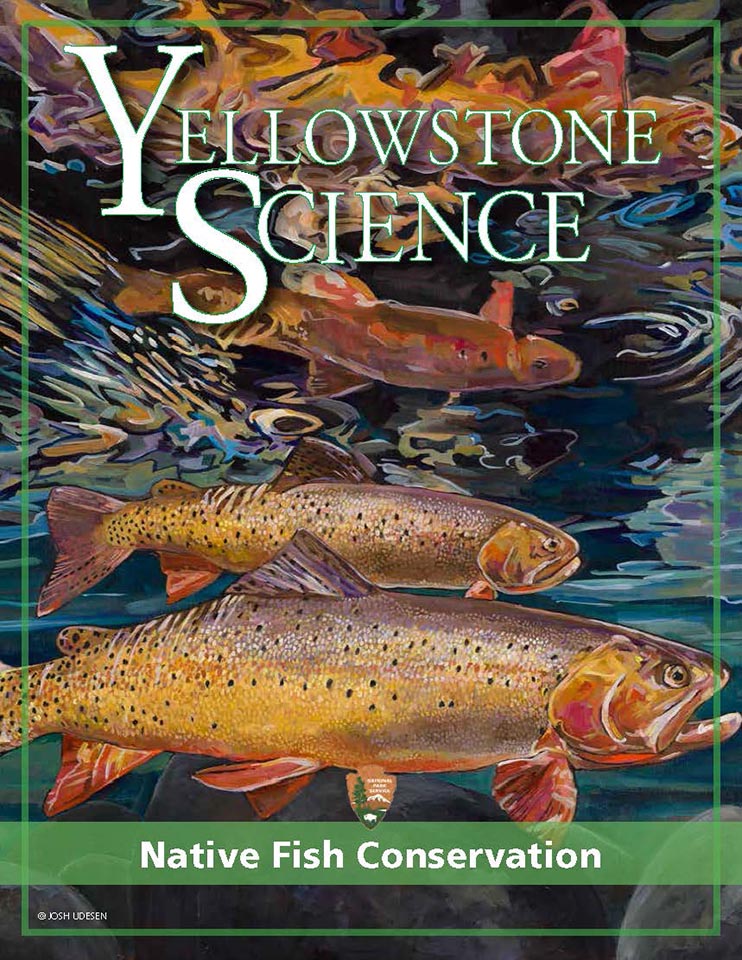
    YELLOWSTONE SCIENCE
    Native Fish Conservation

    DOWNLOAD AVAILABLE !
    -------
    .. Starting in 2010 a focused and concerted effort was implemented to conserve the native fish of Yellowstone National Park.
    .. Although, in the past, there have been smaller programs to the same end, this is a park wide and species wide effort.
    .. This report from Yellowstone Science is the first significant release of the program scope and results to date. Public meetings and listening sessions have taken place over the last seven years. This report ties together the dribs and drabs of information that have trickled out over the last seven years.
    .. The body of the report is 50 pages, including the bibliography and references.
    Appended to the report are:
    >> Note from the Yellowstone Lake Working group,
    >> Note about suppressing non-native Lake Trout,
    >> Note about fish population responses to suppression,
    >> Women in science,
    >> Movement patterns and areas for spawning Lake Trout,
    >> Lake Trout supression [sic] alternatives to gillnetting,
    >> Protection from aquatic invasive species,
    >> Trout facts,
    >> Volunteer activities,
    >> Schweber note on catching locations.
    >> Birds and mammals that eat cutthroat,
    .. Download it HERE-1 or HERE-2.
    -----
    SIERRA BRIGHT DOT - WORKS!
    .. The bright grayness has arrived with a warm mixed drizzle of snow and rain. Perfect fishing weather. The mush will keep the fair weather fishers off of the trails  whoot, whoot!
    .. We'll don the gear and brave the warm and wet. Right after breakfast and a nap.
    -------
    THE NEIGHBORS GROW GOOD WHEAT


    Tuesday, March 13, 2012

    Native Fish Get Boost

    $1,000,000 = $2,000,000
    Grant Matched By NPS
    just a start
    SEE THE LAKE TROUT?  SEE THE CUTTHROAT?  YUM, YUM !!
    -------
    ..The Yellowstone Park NATIVE FISH CONSERVATION PROGRAM has been given a boost by the finalization of the $1,000,000 grant from the Yellowstone Park Foundation.
    .. Last December we noted that Yellowstone Park was embarking on a comprehensive program to protect and preserve native fish stocks. That program is now underway with the infusion of funds and the implementation of the plan.
    .. The recognition that the native fish and their abundance and distribution and behavior constitute a vital link in the ecology of the park has led to this action. As a food source for grizzly bears, birds, coyotes, otters, and other animals the native species are vital to the health of the ecosystem.
    .. This effort is designed to address all aspects of the concerns about the dwindling populations of native fish and will guide management for the next two decades and beyond.
    .. A major concern, of course, is the impact of Lake Trout on the native cutthroat population. Efforts to ameliorate this impact will include stepped-up gill netting efforts, research, and plans to create a resiliency in the native fish population.
    .. It will probably take six years to accomplish the major goals of the project. During this time future strategies and management plans will also be developed to insure that the native fish population can be successfully managed in the face of:
    ** Predation by non-native fish such as Lake Trout and Brown Trout,
    ** Hybridization with non native Rainbow Trout,
    ** Drought, climate change and fishing pressure.
    .. The top priority of this action is to decrease the number of Lake Trout in Yellowstone Lake.
    .. Additionally the project aims to:
    + Restore Yellowstone cutthroat trout to waters within the northern portion of the park;
    + Develop a westslope cutthroat trout brood source;
    + Continue long-term restoration efforts of westslope cutthroat trout; and
    + Begin to restore Arctic grayling within the Gallatin and Madison drainages.
    .. Information Resources:
    -- Yellowstone Park Foundation Announcement,
    -- Yellowstone Park Information Document (PDF),
    -- FONSI Native Fish Conservation Plan (PDF),
    -- Native Fish Conservation Plan EA (PDF),
    -- Native Fish Conservation Plan EA;  Chapters 1-5 (PDF),
    -- Native Fish Conservation Plan EA; Appendices A-F (PDF),
    -- Native Fish Conservation Plan EA; Appendix G (PDF).
    -------

    Tuesday, December 21, 2010

    Very Important Download

    NATIVE FISH CONSERVATION
    EA Available
    3-part PDF

    -------
    .. In Rapid fashion Yellowstone National Park and the National Park Service have completed the Environmental Assessment for the Native Fish Conservation Plan.
    .. We just received notification and downloaded the files. We'll study them and let you know our thoughts.
    GET THE EA & APPENDICES HERE.
    -------
    .

    Thursday, August 26, 2010

    A Little Hint

    THE PARKING IS EASY
    The Walking Is Tough
    the catching is simple
    take a very long 4-weight

    Friday, July 16, 2010

    A Pair Of Sweethearts

    NOT FOR HEADHUNTERS
    Avoided By Braggarts
    browliners don't even pause
    your 2-wt. is too heavy !
    beautiful rare fish

    (click on all images for high resolution views)
    -------
    .. It's not that we're secretive. It's not that we're selfish. It's not that we enjoy wildflowers, vast meadows, or wildlife to the exclusion of fishing. It's just that some places are so near and dear that they must be discovered to be appreciated.
    .. There are a pair of streams, (trickles really,) about an hour or so from home that we visit a couple of times a year.
    .. The are in the high country. They are spring fed. They parallel each other and, at one point, are less than 200 yards apart, and oh so different - one from the other.
    -------
    .. One of them is in the open for most of it's length, (not quite 2 miles.) It runs in the sun with only an occasional tree or bush on it's banks.
    .. Tall grass is the cover for shade. The banks are hardly undercut at all, and the shade is as important as a bowling ball sized boulder.
    .. The other is shrouded in mystery. Thick brush overhangs the banks. Trees and their roots contort the stream into surprising convolutions as it wends it's way through an incised bed.
    .. Deep, (up to two feet,) holes are always productive - if you can get to them. Ants and other bugs rain on us as we sneak through the growth. The fish are there, and hungry, and willing.
    .. Neither is a fertile stream. Neither is full of bugs. Neither is inviting to the fisher folk of today. They are intimate, quiet, clear, cold, and pristine. The fish are uneducated, diminutive, and spooky as can be.
    .. The feather merchants don't know their names. The guides never heard of them. Some neighbors think they are devoid of fish. Fishers drive past them and never even know they are there.
    .. There is wildlife everywhere: not the moose or elk or bear, or deer, (though they are here,) but ducklings, meadowlarks, ground squirrels, shrews, voles, flies, moths, ants, beetles, and such.
    .. The birds have the usual high altitude habit of fluttering from bush to bush and hide to hide.
    .. It's comical and occasionally surprising, (like a covey of huns bursting through your legs as you scan the horizon.)
    -------
    .. We stalk the stream banks with a hand line, (5 feet of 5x tied to a golf tee - the fly is a bit of thread wrapped around a size 20 or 22 hook.) On the open creek, we crawl on our belly in the wet ooze of a perched water table. If nothing else it keeps us cool.
    .. We turn over the cobbles at the edge of the water. Granite and quartzite, are predominant here; not the volcanic's of Yellowstone.
    .. These mountains were here long before Yellowstone. They were here before the enormous eruptions of the super-volcano. The fish have endured glaciation, vulcanism, earthquakes, fire, drought, and other forces of nature: tough little scamps they are.
    .. The food is sparse and very small. We recognize some of the fodder; most we don't. The green ones are easy. The stillborn neotenous forms are difficult!
    .. We sometimes are so good at this creeping and crawling that we can tickle a fish in the belly. Most of the time a squadron of small fish zings ahead of the small silt plume that we cause. They are fast little devils: dark, glinting shadows in the water so clear it seems to disappear.
    .. We fish for them downstream with a calculated drift. Little swirls, eddies, cobble pillows and other currents must be taken into account.
    .. We place the fly in the water by hand. It takes some stealth and time. A long drift is three feet. We scare a lot of fish. There are a lot to scare. Monsters run to 6 or 7 inches. They leap and splash and we net them and turn them loose.
    .. There have been occasions when we just look & watch. Little fish, with colors and patterns to cause a bit of wonder. They are so bright out of the water. They disappear in the water. It's tough to see these little jewels. It's really a shame to catch them. We limit ourselves to two per creek per visit.
    .. These are wild, indigenous trout. Westslope Cutthroat of the purest sort. A handful of biologists know that they exist. Some of the neighbors have visited them. No one goes to these creeks to fish, (save a couple of us crazies.)
    .. It's as much about the place as the fish. Untrampled meadows, wildflowers, green's that defy description, and solitude are the attractions. There is a road nearby. It even has a forest service number.
    -------
    .. We don't know if what we do is fly fishing. There's no vest, no fly rod, no fly reel, no waders, no fly boxes, no forceps, no accouterments from major catalog companies, and certainly no question of keeping the fish.
    .. There is no false casting. Neither is there a chance to mend the fly line. Hell, there is no fly line. We use a large net designed for home aquariums - does this qualify?
    .. What ever it is we are doing it gets us out of a crowded tourist town. It lets us breath air thin, cold, and pure. It gives us the opportunity to visit with descendants of ten thousand or more generations of successful adaptation to a very harsh, pristine and beautiful part of the world. That's plenty good enough.
    -------

    Tuesday, June 15, 2010

    NOROCK At It Again

    WESTIES IN GLACIER PARK
    Displacement & Hybridization
    same song - different verse
    we'll miss 'em

    -------
    .. The Northern Rocky Mountain Science Center, (NOROCK,) and the National Park Service have begun work on a management plan to protect and restore the Westslope Cutthroat Trout in Glacier National Park.
    .. The project will establish baseline genetic and distribution data that will allow informed management decisions for both the park and the western United States.
    .. One of the most important aspects of the study will be to address the extent of pure strain cutts in the waters of the park. Many populations of Westies were 'assumed' to be non-hybridized in the past. This has led to controversy in the decision by the USFWS not to list the species as threatened or endangered.
    .. The controversial court decision suggested that genetics are irrelevant and that morphology is what should decide the status of the species - SO - if it looks like a cutt . . . . (to who?)
    .. We've mentioned this in a previous post, and recently noted a similar effort that is just beginning in Yellowstone National Park, to manage the native species.
    .. Speculation is that non-hybridized Cutthroats will disappear at about the same time that the glaciers leave Glacier National Park. New naming conventions will then be in order. We suggest "Glaciated Unnatural Park" to solve the nomenclature problem of both circumstances.
    .. The specific objectives of the NOROCK project are:
    #1] Map the distribution of WCT and hybridization in GNP. #2] Assess spatial and temporal patterns of hybridization and relatedness among WCT populations. #3] Develop site-specific management alternatives for conservation and protection.
    For more information contact:
    Clint Muhlfeld
    406-888-7926
    cmuhlfeld@usgs.gov
    -------
    .

    Wednesday, May 12, 2010

    Wally McClure Creek

    THE WESTSLOPE LEGACY
    Pet The Fish
    or just watch
    -------
    .. Walter “Wally” V. McClure (1961–2003) prowled around the neighborhood visiting those places where the Westslope Cutthroat Trout just might be lurking.
    .. These are places long forgotten by the habitues of our nearby glory waters. These are places where the water is clean, cold, clear and generally small.
    .. In a scrap of water formerly known as "the ditch," or as "AOUF Ditch," Wally found a population of genetically pure cutts.
    .. These fish and this stream have had no small significance in the efforts to preserve our native fish. This population is one of the few populations that occupy their native habitat, (only 8% - 20% of historical habitats are currently occupied by genetically pure Westslope Cutthroats.)
    .. On April 13, 2010, the U.S. Board on Geographic Names approved the naming of "the ditch" as "Wally McClure Creek." This is more than appropriate and certainly a fitting honor for both the creek and the man.
    .. You can read more about it:
    ==> Gallatin National Forest News Release,
    ==> Montana State Names Authority,
    ==> Montana Topographic Map Finder,
    ==> AFS Letter of Support, [worth the read],
    ==> Wally McClure Scholarship.
    .. For an overview of the status of this fish check the 2002 report of The Westslope Cutthroat Interagency Conservation Team.
    -------
    .

    Thursday, April 15, 2010

    See You There

    MOM COOPERATES
    Bring SPF 15 - 20
    -------
    .. After a bit of a blizzard, the yellow orb of heat is back and it should be perfect for driving to West Yellowstone.
    .. The National Park Service, Yellowstone National Park, is holding the "Public Scoping Open House" for the Native Fish Conservation Plan / EA -- TONIGHT !!
    .. Directions to meeting above, click for larger, printable view.

    Monday, May 12, 2008

    Cutts Back In News

    KILL SOME
    SAVE SOME OTHERS

    Public Involved In Preserving 'Westies'
    image courtesy jasonjdominiac.com
    .. A Year ago, and again last Fall, (September, 15,) we noted the New West article about the project to replace one natural fishery with another.
    .. Now the Missoulian reports that the project will be on public display at a public informational meeting in Kalispell tomorrow. The meeting is to be held at the Montana Department of Fish Wildlife and Parks agency office between 5 and 9 PM.
    .. Biologists and fisheries staff will be on hand to explain and discuss the rotenone poisoning in the Jewell Basin.
    This ten-year project has attracted conservationists and fishers of all stripes and is not without controversy. The treatment of the back country lakes and rivers is detailed at the FWP site.

    Saturday, September 15, 2007

    The Slowly Falling Autumn

    THE WEATHER OUTSIDE'S DELIGHTFUL
    Bears Doing Bear Things
    Elk Doing Elk Things
    Cutts Getting Attention
    prescribed burn announced
    FISHING REPORT TOO
    elk_vs_elk
    .. The gentility of the weather has produced a bumper crop of visitors to Yellowstone National Park. The glorious Fall weather is occasionally punctuated by a snow flurry or cold shower - often accompanied by a bit of a blow. All-in-all it's just too nice to be the middle of September, (we're waiting for October's revenge.)
    ===========
    .. The fourth grizzly bear attack occurred yesterday. This one was in the park. As we noted earlier the bears are restless this year - numerous too! Click over to The Seattle Times or the Bozeman Daily Chronicle for the story and the YNP page for the press release. Just before you get your fresh leader and specialty flies you should get a big canister of bear spray. Wear it where it is quickly and easily grabbed - not in your back pack. Get the big one and practice how to use it. Portions of Yellowstone and adjacent Forest Service lands have been closed to human entrance because of the attacks. It's interesting to note that no report of the attack said anything about bear spray. Despite the video below, karate does not work!!
    .. Bears are not the only cranky animals in Yellowstone. Elk and bison can also do serious harm to humans during the "Testosterone Season." The video clip below shows how not to view animals in Yellowstone.

    ===============
    .. If you are planning to fish in the Norris area on Monday, be advised that a 65 acre prescribed burn will take place southeast of Norris. This could affect your eyes if you're planning to fish the meadows around Wolf Lake or Virginia Cascades. Additional information and instructions for the press are included at the NPS site. The fire in the Cascade Corner continues and is not of any immediate danger to fishers on the Bechler River or Boundary Creek. However some backcountry trails and campsites are closed.
    ==========
    .. West Slope Cutthroat continue to attract the attention of concerned citizens. New West reports of an effort by the Bonneville Power Administration and Montana Fish Wildlife and Parks to begin restoration of Cutthroat populations in the Flathead River Basin including parts of the Bob Marshall Wilderness. The restoration effort will take place over the next 10 years and use rotenone to kill the entire aquatic population of fish in several stream segments and lakes. A large population of Whitefish and Bull Trout, (a threatened species,) will also be killed. We anticipate that a similar effort will take place in the future on Slough Creek in Yellowstone if fishers continue to release Rainbows and the hybrid Cutbow population continues to grow. The online version of the Yellowstone Fishing Regulations, (pg. 16,) says:
    Non-native rainbow trout also interbreed with native cutthroat trout, producing hybrids. Once this happens, a cutthroat population can be restored to genetic purity only if all fish are removed from a stream and genetically pure cutthroat are reintroduced. To reduce hybridization in the park’s cutthroat trout waters, anglers are encouraged to harvest rainbow trout.
    =============
    .. Hebgen Lake and Quake Lake continue to provide great catching as does the Hebgan Tailwater. The morning gulper fishing is still rewarding but the Callibaetis are thinning out. Late afternoon at the narrows or in the Madison Arm are still a viable proposition with hoppers - (we're surprised and delighted at this.) Midges and a few Caddis continue to keep the area around Campfire Lodge a viable proposition throughout the day. From Awkward Bend to the Choice Hole eagar fish are taking both the small Caddis nymphs and dark green Woolly Buggers. The fish seem to have moved from the edges to mid-channel as they move up from the lake.
    .. Some small pre-spawn fish have moved into the South Fork of the Madison River and are podding up in the estuary. The neighbors with worms have found the fish in the estuary but the willows make access difficult upstream. Small streamers and Hare's Ear or Prince nymphs should gather up some nice 12" - 16" fish. There is no sign of the run above the highway.
    .. The Madison River between Hebgen Lake and Baker's Hole is jam-packed with parked fish that are slow in moving further upstream. The neighbors are reporting some fish to 20" - all Rainbow Trout so far. Besides worms, Thunder Creek, Dark Spruce, Yellowstone Spruce, and black Woolly buggers seem to be the ticket to dance in this segment. There is the beginnings of a Caddis hatch at about 4:30 - 5:00 around Baker's Hole - sparse at best; the afternoon winds may make it hard to see the bugs and the rising fish. Size 16 Elk Hair Caddis on top with a size 14 Rock Worm dropper is an excellent prospecting rig.
    ==========
    .. Salubrious weather and low flows continue on the west side of Yellowstone National Park. The Madison River from the park line to 7-mile bridge has some medium-sized Rainbows that are causing a rustle in the pubs. The early morning Trico spinners are getting very sparse and the evening Caddis are even less apparent. From National Park Meadows to 9-Mile Hole is a desert during the mid-day heat, (rightly so,) and only two fishers were seen in this six mile section today - wonder why.

    .. The Gallatin River can be fished all day if you choose. Cover a lot of ground and prospect with a hopper - dropper rig during the heat of the day. Sometimes a pair of drowned hoopers of different patterns will produce. Stick with the smaller hoppers and beetles.
    .. The best fishing on the Gibbon River continues to be above Norris Campground. Afternoons with a 3-weight and a box full of terrestrials and attractors will provide you with many dances if you're willing to stroll from hold to hold. It's a wonderfully pleasant way to enjoy this sterling little river. Be sure to look around and watch for bison and bears - a few bars of your favorite drinking songs will go a long way to keeping you safe. The riffle and run waters of the canyon are holding some nice Brown Trout, as is the pocket water around Chocolate Pot Spring. Again nothing fancy other than your approach is needed.
    .. Slough Creek is producing excellent fish in from the late afternoon to the evening. It is clear, cool, and low. Terrestrials are present and will move fish -- BUT -- don't be sloppy. The big fella's are not likely to be taken with the same poor approach twice. There is a growing hatch of BWO's and midges to accompany the still present hoppers. Soda Butte Creek, in the confluence meadows, is full of late-blooming hoppers - as is the Lamar River from Buffalo Ranch to Cache Creek. A little color creeps into these waters from afternoon showers, but so far the rains have been light enough to allow pretty good fishing, (we know it won't last.)
    .. For those willing to work for fish the Yellowstone River, in it's popular sections, will yield 15" - 20" Cutts on well presented Baetis imitations. Prince & Gold-Ribbed Hare's Ear nymphs will produce good fish if you are very attentive. Keep the flies on the small side, (16 - 20 on top and 12 - 16 below.) One area that has gathered up a dense population of fish is the area immediately downstream from Tower Creek. There are also fish to 18" in the lower stretches of Tower Creek.
    .. Down south, Jack Dennis reports that the lakers are podding up for the spawn in Lewis Lake. The reports for the Gardner River system from Parks' Fly Shop suggest that if you pick your place, day and fly you should be amply rewarded. Give them a call and tell them hi for us.
    ===========
    .. From Protect Your Waters comes good news about the battle against Rock Snot. They also bring us a bit of bad news about the two species of Asian Carp that have invaded the Upper Mississippi River Drainages. These flying carp would be a bit more entertaining were it not for the impact that have on indigenous fish -- and fishers. The Tunica Times has an excellent article about the impact in Mississippi on the lower river. And there is yet another video of flying carp produced by the Illinois Natural History Survey, Great Rivers Field Station.
    ..

    Friday, June 29, 2007

    Of Fires, Osprey, Swans & Cutthroat

    TOO MUCH GOING ON
    Fourth Of July Fishing Locations Tomorrow
    .. The forest is on fire - it must be August! No; still June. The fire north of town has drawn national attention. It has burned hotter than the 1988 fires in spots. It's not out yet. It's not in the park yet. The Gallatin National Forest office is the best source of accurate news for this fire and the Stage I Restrictions.
    .. There are a few bits of news that have escaped the journalistic frenzy to report a "Yellowstone Fire:" a black bear wandered into town while avoiding the fire, (yes it's that close,) poor thing posed for camera phone pictures in an apartment complex for an hour. It was tranquilized and removed.
    .. A borate bomber lost an engine and had to dump it's load over Hebgen Lake to reduce weight and get safely to the runway at the West Yellowstone airport.
    .. Travel on highway 191 north of West Yellowstone is subject to closure at any time. For road information call the Gallatin National Forest-Hebgen Lake District office, (406)-823-6961, or the West Yellowstone Chamber of Commerce, (406)-646-7701.
    .. The cause of the fire is still under investigation but the crews on the line have intimated that it was an illegal campfire by illegal campers - we'll see.
    -------------------------
    .. Terry McEneaney, Yellowstone's ornithologist has reported that the Trumpeter Swans of Yellowstone are dwindling in numbers. So too, the Ospreys.
    .. The ospreys are losing ground because of fire and diminished cutthroat numbers. An article in the Casper Star Tribune has the details; money quote:

    One of the biggest problems for the osprey is that Yellowstone cutthroat trout, a key food, has been hit hard by nonnative lake trout in recent years. At one spot on the lake where more than 70,000 cutthroat were counted in the 1970s, just 471 were tallied last year, the lowest number since record keeping began in 1945. There are other factors, too, including a 2003 wildfire on Frank Island, in the middle of the lake, that burned 570 of the island's 600 acres, wiping out nearly all the old-growth trees that were a popular spot for nesting ospreys.

    ---------------------

    .. Time to get some biscuits and gravy. The folks at the horse's mouth have provided us with a lot of conversational fodder.