THE REAL LAST BEST PLACE
It's 3:30 AM - Yawn
we're going fishing

-------

-------


 .. Baetis are surprisingly regular this year on the Gallatin River in the park. Hoppers are present, as are the few remaining spruce moths. Beetles and ants are strong performers, particularly on warm days. There have also been several flights of cinnamon ants reported around Black Butte and Specimen Creek.
 .. When they hatch, the small caddis are preferred munchies in the evenings. Attractor fishing is a local tradition on the Gallatin River in Yellowstone National Park. This has been the mid-day pastime for a few generations and it persists today.


 .. Just a note to remind you that the Madison River will soon be just chucky-jam-full of fresh fish from Hebgen Reservoir.
 .. Thunder Creek. When was the last time you heard someone recommend that old fossil? Who do you know that fishes it? They are either very good liars or just plain secretive.
)N.jpg) .. Original Olive Matuka. These are tied commercially but their sales are way off. Although infrequently used these days, there is probably one in your fly box. There may be several tucked away in the corners. They most probably are unused and forgotten. Drag one out and give it an honest try. The early morning is a good time for the darker ones. Dead drifted or rapidly stripped downstream in the undercuts, it may just surprise you.
.. Original Olive Matuka. These are tied commercially but their sales are way off. Although infrequently used these days, there is probably one in your fly box. There may be several tucked away in the corners. They most probably are unused and forgotten. Drag one out and give it an honest try. The early morning is a good time for the darker ones. Dead drifted or rapidly stripped downstream in the undercuts, it may just surprise you. . Chenille Matuka. Bright and boisterous, this variant is also tied commercially. It looks too gaudy for most "serious" fishers. It is a visual disaster in just about any fly box. It's not on the lips of the romantic poets of Yellowstone lore. Yet this variety is as good as or better than the original. The tail is splayed and provides nice action in the depths of dark pools. Sizes up to #4 and 4XL are not uncommonly found stuck in the noses of eager trout in the willows below the Highway 191 bridge, (you will have to walk to get these skulking monsters.)
 .. Bead Head Rubber Legs. There are a bazillion rubber legs flies. They have secret names as well as commercial names.
 .. Guide's Secret Rubber Legs. Not a secret any more. Seven or eight years ago this pattern was hidden in dark places and fondled frequently in anticipation of Fall fishing.
 .. Hackle & Legs. Here's another rubber legs pattern that has been embellished with long widely spaced palmered hackle. This one can be made to float with enough goo, or what ever is your favorite flotant. The many dimples create little lenses that allow the light to be seen. Strikes can be explosive - especially after a slight twitch.
 .. Woolly Worm. The poor thing: fallen into disuse and disgrace. Often mentioned in the same sentence as the San Juan Worm. The Fall sizes and variations are not within the traditional range for this old sweetheart, (how many do you have?) Sizes in the 2 - 6 range are not uncommon. Long hooks are used by the neighbors. Red buck-tail is used for an afterburner. Very long, (for hook size,) hackle is the norm for this time of year. Traditional yellow and black are frequently the choice for the area around the Barns Holes and the Local Hole #1. More often, the last couple of years has seen hot orange or bright rust being chosen for the big water just above the estuary.
 .. Pheasant & Blue. This streamer is a staple along the Washougal River in Washington and on the upper Clearwater River in Idaho. The pheasant rump feathers are popular in both steelhead and salmon fly patterns. Fishers on the South Fork of the Snake River in both Idaho and Wyoming have used this pattern for a couple of decades to take large migratory cutthroat trout. This pattern is now finding it's way into secret stashes of some of our neighbors. We've not used it but they swear by it - and at it.
 .. Brindle & Hen. This popular fly from Northern California locations around Hoopa, Eureka, and Salyer has been modernized by the recent explosion of color in chenille. Similar in form and function to the classic Brindle Bug this fly is not just another pretty face. Tied with a heavy wire under-body it bounces through deep riffles with undulating sex appeal and is hard to resist by submarines parked in the dark spots during mid-day. This is a useful probing fly when tied with no underwire support and the action is leech or eel like. Just the groceries a fresh-run fish is looking for.
 .. Bead Head Glitter Nymph. This monstrous cousin to the standard pheasant tail nymph is persistent in the repertory of the big-fish catchers in the neighborhood. It's easy to tie in sizes 4 - 8 and makes an excellent fly for the low clouds and bright overcast days of late September and October. It has nearly replaced the Casual Dress in our box and we don't regret it. Bleached goose biots are becoming rare these days. White will work just fine - or do some yourself.
 .. Sinking Hopper. It's nearly time for the sheep to call it quits on their hopper box. The feather merchants have run low on their stash and are touting the flies of fall. Grasshoppers in the high country continue to grow and molt through the first couple of weeks in October. A hard frost will "knock 'em down" for a while.
 .. Dark Spruce Fly. This classic has persisted despite the hawking of "more modern" flies. There are many variants and they seem to be quietly proliferating. We prefer ours tied a bit on the sparse side and choose to use a barred furnace hackle tip of a mahogany color rather than the traditional golden badger hackle.
 .. As always the Light Spruce Fly is doing it's share of catching as well. Many of the neighbors fish it as a matter of course. With a short leader and a herky-jerky strip in a deep dark pool it will allow you to see the fly and the take. It seems to work best at mid-depths - but will take fish throughout the water column.
 .. Furnace & Red. This fly has been a staple for our Fall and Winter fishing since sometime in the late 60's. A couple of dozen were a gift from a fly fisher in Pocatello, Idaho. He may have "invented" it.
 The Little Brown Trout. Dear to the hearts of Montanan's that love our cutthroats. There is a satisfying surge of glee, (it arises somewhere between the epitome and id,) when one of these little flies gets eaten. This old pattern is seen in most fly boxes and is only occasionally used. It is special only in the hearts and minds of ancient neighbors that remember what a glorious bit of water the Snake River was without the scourge of the invasive Brown's. Fish it like the little streamer that it is. Shallow riffles, deep undercut banks, and deep slicks are it's prime hunting ground. Even the Browns will eat it.
 .. Stonefly Nymph. They live here. They get dislodged. They float around in the water column and get eaten all year long. Of course they are a Springtime religion, but the trout will eat one that's floating by any time of year. Often the older neighbors tell us to "hit 'em in the nose." That's good advice if you know where the noses are.
 .. Baker's Hole Bugger. Straight from Blue Ribbon Flies & Whiskey Creek Fishing comes a fly designed specifically for the water around Baker's Hole. It's a fly that has been "making the rounds" for a few years and shows some staying power. Although supposedly designed "for Brown Trout" the fly is just fine for pricking hungry trout of any stripe.
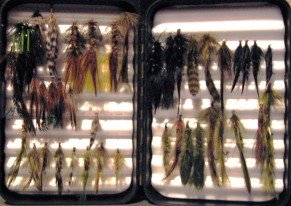 THE FALL FLY BOX


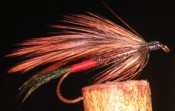 It can be tied in a traditional, streamer style, or as a Matuka. We use both. We also tend to use flies that are a bit bigger than the conventional wisdom dictates. There seems to be a subconscious message in our hard-wiring; "size matters." We also prefer furnace hackle with a touch of green - if we can get it.
 folks in the neighborhood. They fish it less than the dark one. It too, can be tied in either style. Again we prefer a darker and off-color wing to the stark white of the traditional recipe. It is almost a sure thing that any fall fisher will have this fly in the box come Labor Day.
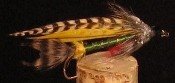 .. The Yellowstone Spruce Fly is tied in a manner similar to the dark and light varieties. It uses materials that are at variance with the traditional recipes and is probably not a "real" Spruce Fly. It has a small but dedicated following among old-fart-fishers along the Henry's Fork, Madison, Firehole, and Gibbon Rivers. This streamer has two variants. The one shown here is the most popular. The other uses a green under wing with a yellow body and green butt. We fish this one, other folks use the other one - they both catch fish.
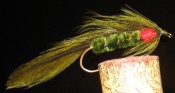 .. The Green Matuka Egg Fly is reappearing in many fly boxes. This was a popular fly 15 years ago on the South Fork of the Snake River. It is seeing use on the Madison and Firehole Rivers right now. It's just a Matuka - tied a little long. Some use red for the egg, some use florescent orange, some use yellow - don't seem to matter much.
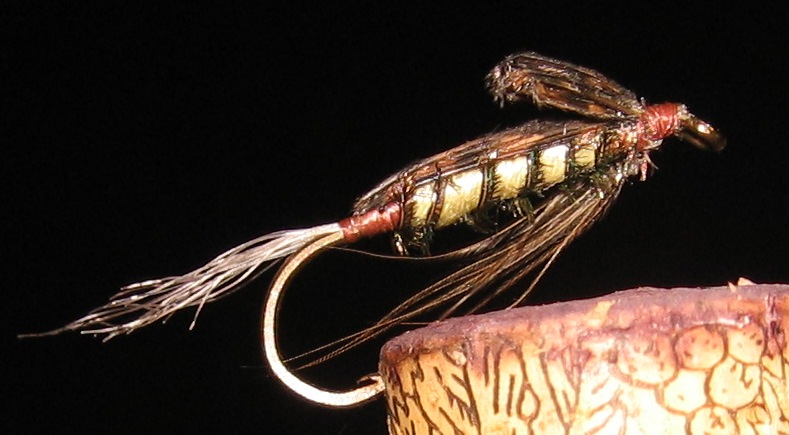 .. The Yellowstone Sally is generally tied in Stone fly sizes for spring fishing. When tied on a long shank hook, with a long tail, it's a very durable and serviceable streamer - of sorts. It is best in the early Fall, (like right now,) and seems to lose it's appeal as winter approaches.
 These are excellent flies for the big plunge pool at the base of Gibbon Falls. They also work in the very early morning or late evening on the Gallatin River in the deep dark pools.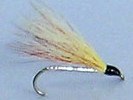
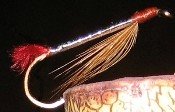 These are usually tied very sparsely and fished deep on a dead drift. They serve as both searching flies and as mid-day flies, (the tinsel seems to be the key - or the contrast - or . . .)
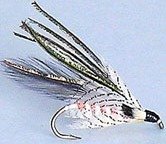 as tied by Stevens, or it's shorter-shanked commercial versions is creeping back into the fly boxes of the Fall fishers in Yellowstone National Park. Most of the visitors, when asked, explain that they use it because they like it. The neighbors have a different reason - ". . . tried everything else." This fly is usually fished on a mended swing. Make it as slow as you can and mend and back-strip to keep it as drag free as possible - a strip-set is usually required when the take happens. If fished too far away it is probably mouthed and rejected -- and you'll never know.
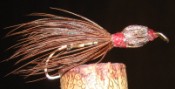 .. The Thunder Creek is an old, stodgy, plain-looking, killer fly. It is seldom seen these days, and that is a mystery to us. Depending on conditions, trout preference, and personal preference, this fly can be tied long or short, full or sparse, bright or dull, or any combination - above and below the shank. We prefer a rather short and medium-full rendition. We use plucked pheasant rump fibres and red thread. Some of the neighbors tie it very sparse and with plucked hen hackle, (black or grizzly,) and yellow thread. Fish this one on the swing with a taught line and at the end of the swing let it dangle in the current right in front of the nose of big fish.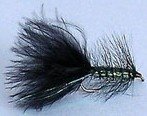
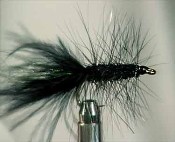 .. The Woolly Bugger is mandatory. This staple of most fly boxes is most popular in black, (dark green, olive, brown, gray, and even yellow are also seen.) With the advent of synthetic materials, this fly has many variants. We usually stick with black or olive and occasionally add just a bit of flash to the body. Sometimes a few strands creep into the marabou fibres too.
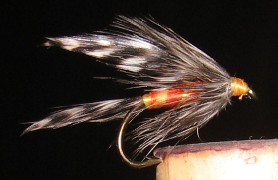 .. The Quick-N-Easy seems to be limited to the Lamar River, the upper Gibbon River, the Yellowstone River, and infrequently it is seen on Slough Creek below the parking lot, and along the road section. This is probably a cultural difference in feather merchant preference as much as a trout preference. We use it on the Gallatin River and the Madison River and it works just fine. The fly goes together quickly and is very durable. Just one kind of feather - two kinds of floss - one color thread.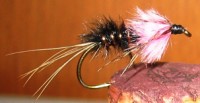
 .. The Feather Duster is almost a lost tradition in Yellowstone Fishing. The original was actually made from the material in feather dusters. It has some color variants. Tied in the smaller sizes this is a very effective spring and summer nymph. The larger yellow and especially pink versions are frequently just the thing that late Fall migrating spawners are looking for.

 The fall hatches in Yellowstone can range from apparent to negligible - they don't ever seem to be spectacular, (save for the occasional "snow fly" marathon.) The Caddis is the one we use most, followed by the cinch, then the BWO, (which will do if the Baetis appear.)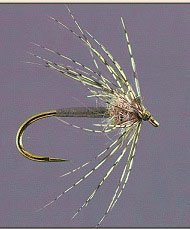
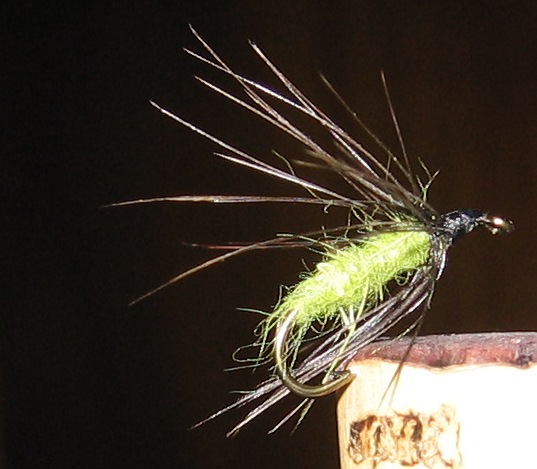 And, tied correctly, they are surprisingly durable. The stiff hackle variant is less well known and probably less effective for Fall fishing. We only use two colors and several sizes of this endearing fly: The Classic Version with barred hackle, and the Green Thing with dark furnace or black hackle.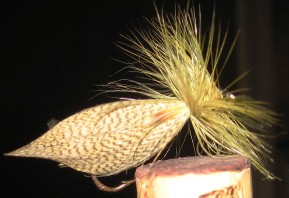
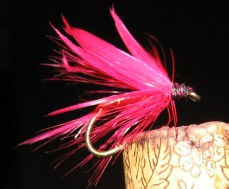 .. Wet flies and others tend to overlap in use and definition. In the summer we float a Hornberg and pretend that it's a hopper. In the Fall we sink it and pretend it's a wet fly. We also use a Scarlet Ibis with magenta feathers and sometimes a gold rib. The double wings of the early traditional patterns separate and be become a large bright mass. The fish don't seem to mind, (or even prefer it?)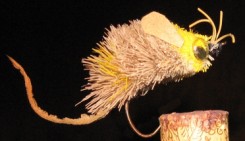


.jpg)