• PARTNER: PROTECT YOUR WATERS
  • Go To: THE FLIES OF YELLOWSTONE
  • Go To: YELLOWSTONE FISHING WEATHER
  • Go To: YELLOWSTONE FLY FISHING MAPS
  • Visit: Moldy Chum
  • Visit: The Horse's Mouth
  • Visit: Chi Wulff
  • Visit: Parks' Fly Shop
  • Tuesday, May 13, 2008

    The Spring Fly Box - Redux

    JUST A LITTLE CHANGE
    The Scene's The Same
    just two months later
    ---------
    BREAKING NEWS
    Fantastic Scientific Research Results
    .. Below is last years post about the spring fly box. We've added just one fly this year. The Shop Vac. With snow currently on the ground and it snowing on and off all week it seems that the bug activity will be mostly underwater.
    -------
    .. This is as close as we come to recommending flies for fishing. We have used some of these patterns for 40 years or more - really - and they continue to work. They do not satisfy the need for experimentation, nor do they tickle the fancy of feather merchants, nor are they the latest and greatest; they just suit us.
    .. Other flies work fine, and other flies may even work better. One old local fly fisher was fond of asking and answering a question in the same breath: "Why are there so many flies? - Because they all work!" We agree.
    .. Spring fishing in and around Yellowstone National Park is weather and runoff dependent - no surprise there. The weather can be brutal well into June, and the runoff can keep you off of the water for days, (or weeks,) at a time. The flies shown here are designed to work well in a variety of conditions and in that sense are "generalized flies." There are some that could be considered 'imitative,' however most will fall into the 'attractor' class - that's O.K. with us. Got'ta attract a fish to catch it.
    -------------------------
    THE FLIES

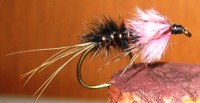
    .. Montana Duster: We use piles of these all season long and start the Spring nymphing with it. This pattern, and the original Feather Duster are staples in our Spring assortment. The yellow color is most popular. However, about this time each year the pink makes an appearance - probably taken for an egg - who knows? Sizes: 6 - 18.
    .. Yellowstone Coachman: The occasional day in early Spring that allows a good hatch is an unanticipated joy. The fish are seldom very selective, (well - sort'a,) and this fly works wonders. Sizes: 10 - 18.
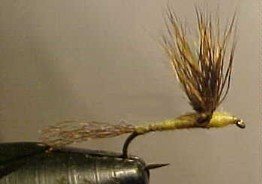
    .. The Yellowstone Cinch: This is our other choice for early Spring dry fly days. It is a local adaptation that floats like a cork, and can be quickly tied at home or on the water. Size is the key to this and other early season flies in Yellowstone. Later the fish become much more selective. Sizes: 10 - 18.
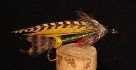
    .. Yellowstone Spruce Fly: This fly was developed by some neighbors that use a bubble on a spinning or casting rig for Fall fishing. It is an exceptional fly when casted with a fly rod in the spring. It's a bit gaudy for many of our purists, but with a nice slow presentation in the cold waters of the early Spring it looks like a big sack of groceries to hungry trout. Sizes: 4 - 12.
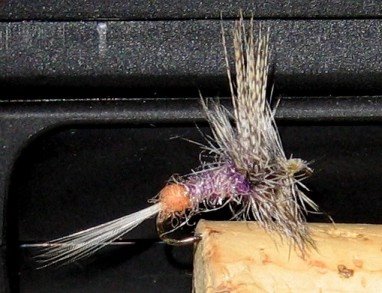
    .. Yellowstone Morning Glory: This is an all season fly that we like to keep handy for fishing in the film, or slightly submerged in the Spring. It is a traditional 'early morning' fly for those that find the right foggy morning after the rare early Spring hatch. In the Summer it's a useful attractor. There are many flies similar to this local variant and most will do - we use this one. Sizes: 10 - 16.
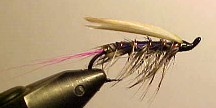
    .. Yellowstone Winter Grub: This looks like nothing other than something to sample - or some such. We fish this all Winter and carry it into the Spring. It's a heavy fly, though it casts well, and is useful for 'dredging' those big fish that you know are there. It's apparently an old fly from the Salmon & Challis area in Idaho. We usually have this in a variety of sizes for the desperation moments. Sizes: 4 - 10.
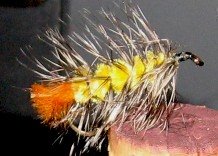
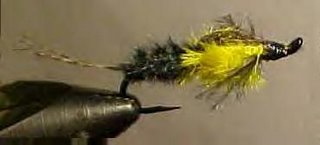
    .. Woolly Worm: Spit the words out of your mouth if you must - it's a great Spring fly in Yellowstone country. Sometimes we use small ones on the surface when the snow flies are out. Black or yellow seem to be the colors of choice, we've got more yellow ones. Sizes: 10 - 18.
    .. Yellowstone Badger: This prickly little devil is one that serves a multitude of purposes. Float it, sink it, splash it, strip it, or just dap it - it is a winner. This fly is similar to the other nymphs that are popular around here - the Pheasant Tail, and the Hare's Ear. We use them all, but keep coming back to this one. Sizes: 12 - 18.
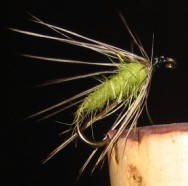
    .. Stiff Hackle Nymph: This variant of the soft hackle variety is not a favorite among many folks in the fly fishing community. It does work well and it is used by some of our 'more mature' neighbors. We've used it since the 80's and found it to be a useful resource - but we tend to forget it too. This is an all season fly that we just put in the fly box because we have them. Sizes 12 -18.
    .. Deer Hair Caddis: This little fly we borrowed from Jason Neuswanger over at The Trout Nut. We fished it all last year along with the local versions and it was a standout performer. It's a dark fly that is consistent with some of our early Caddis hatches and we like it very much. Sizes: 10 - 18.
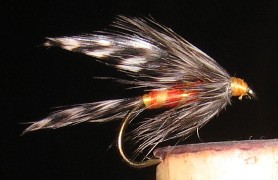
    .. The Quick -N-Easy is one of those flies that makes many a fly fisher cringe. It is gaudy, flashy, big, and effective. It is famous for its spectacular refusals, and that's it's purpose. Tie it on early and then fish the fly that the fish are taking. This will show you that there are really fish in the water, and it may even catch one or two. Sizes: 8 - 14.
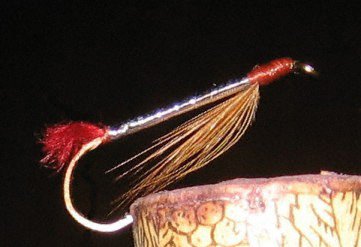
    .. Hellifiknow: This pattern is reminiscent of the Black Nose Dace and Micky Finn patterns. It is useful when the water is murky and you need to get a bit of twinkle down deep. It's a Spring staple and often a 'what if ?' kind of fly for prospecting. Sizes 4 - 12.
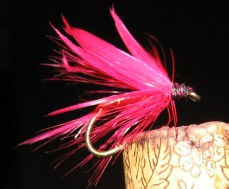
    .. Scarlet Ibis: We've carried this fly since the early 60's. Back then they came on a card and you got four for a dollar. They were imported from Japan and attracted the novice and expert alike. Bit of color never hurts the old fly boxes. This traditional wet fly is one that we fish for fun. It may be taken for an egg, a flying saucer, a cowboy's bandanna, or "who knows ?" - but it takes a few fish every year. Sizes: 8 - 14.
    ---------------
    .. Here's the post on the Shop Vac. It's proven its worth in subsurface fishing over the last few seasons. Tied a bit larger than the traditional sizes it is a fine upper fly in a tandem rig and can be seen on a slow shallow swing.
    .. We have an irrational fondness for the local Feather Dusters, (Original, Montana, Egg,) yet we always have a few Shop Vacs as well. For year-round success these nymphs rank very high. Most people use the bead head variety. Contrarians that we are, we stick with the fluff sans bead.
    .. The recipe lets you know why we're fond of these by the dozen.
    Recipe. Hook: size 12 - 18, Thread: black, Body: pheasant tail fiber, Rib: medium, (or fine,) copper wire, Wing: gold or white Zelon, (cul de canard works fine.)
    Instructions. Move thread to the rear of the hook, attach pheasant tail fibers and the wire, return thread and fibers to head, counter wrap the wire rib to the eye, tie off, attach zelon, (or cul de canard,) on top of the hook shank, whip finish a large clunky head.
    .. These can be greased up real heavy and floated if you choose. The smaller sizes float very well.
    -------
    .. New research results have been released from the Montana State Piscatorial Institute, (MSPI) detailing the findings of fish vision. The results had been delayed for about three years due to the problems of replicating the results from the implantation of sensors in the visual centers of the living trout brain.
    .. The results are scientifically astounding.
    .. Trout have as their main brain component the optic lobes. These highly developed brain tissues are capable of a higher resolution than previously thought, and are capable of providing the necessary stimulus/reaction response to a wide variety of external phenomena.
    .. The single most astonishing finding is that the trout uses this highly developed cerebral mass for a process of transliteration.
    .. The transliteration of visualized objects into desirable objects takes place at the interface of the cerebrum and the optic lobes. This is facilitated by neuro-synaptic activity that was also traced to both the hypothalamus and the olfactory interface. The resulting interplay of these electrochemical processes produce a cognitive impression of an object with attributes of both food and sex.
    .. In simple terms: the trout sees food items as desirable objects in a way exactly similar to the way fisher folks see desireable objects. And the trout sees subsurface objects as the most desirable of all food objects.
    .. Of all the subsurface food items, nymphs are seen as the most desirable of food items and they produce responses that are similar in intensity to the desire for sexual objects . . . in both fish and humans.
    .. The transliteration phenomena was successfully captured by the researchers and reproduced as an image comprehensible to humans.
    .. The image is the product of newly developed technology that not only implants sensors in the trout's brain, but produces output in visual terms. Although some transliteration algorhythms are informed by food of the fish, others are informed by research in humans and adolescent canines as well.
    .. We are fortunate to be chosen as the first place to release this image to the public.
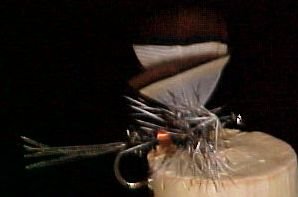
    .. Below is what a Feather Duster nymph, (we provided the research props,) looks like to a trout. We have to admit that the trout has good taste!

    Monday, May 12, 2008

    Cutts Back In News

    KILL SOME
    SAVE SOME OTHERS

    Public Involved In Preserving 'Westies'
    image courtesy jasonjdominiac.com
    .. A Year ago, and again last Fall, (September, 15,) we noted the New West article about the project to replace one natural fishery with another.
    .. Now the Missoulian reports that the project will be on public display at a public informational meeting in Kalispell tomorrow. The meeting is to be held at the Montana Department of Fish Wildlife and Parks agency office between 5 and 9 PM.
    .. Biologists and fisheries staff will be on hand to explain and discuss the rotenone poisoning in the Jewell Basin.
    This ten-year project has attracted conservationists and fishers of all stripes and is not without controversy. The treatment of the back country lakes and rivers is detailed at the FWP site.

    More Snow Behavior

    CHAINS OR SNOW TIRES REQUIRED
    Try This For Awhile


    .. Via Horse's Mouth, bless their hearts !
    --------
    And via Moldy Chum.

    .. Bless their hearts too !
    --------
    .. visit Baitchucker for the best in "NEW RELEASES."

    Saturday, May 10, 2008

    It's Just A Couple Weeks Away

    SNOW AGAIN LAST NIGHT
    Bring Insulated Waders
    to joust or to dance ?
    .. On May 24, 2008 a Yellowstone ritual begins. Opening day for fishing in the park promises to bring a bit of weather for Memorial Day. For those with any time on their legs this brings back memories of days gone bye. Days when the decision to "fish the park" was a problematic one.
    .. The long range forecast suggests a bit of unsettled weather and highs only in the 40' and 50's. We'll keep you posted. One thing is certain: fishing will take place. And just what is this wondrous thing called fishing?
    .. The vocabulary of this fishing thing gives us insight. It is colorful, interesting and revealing. You hear it in the pubs. You hear it in the fly shops. You hear it at the outfitters. It is colorfully embellished and expanded by the guides in conversation with their sports.
    .. The terms are dear to us and we use them unthinkingly: "tough fish," "honker," "killer fish," "toad," "brute," "fight," "battle," "submarine," "struggle," "rod bender," and on it goes. The clear and unveiled under layer of this vocabulary speaks of confrontation, aggression, war, and mortality.
    .. The insidious import of our vocabulary gives insight into the attitude of the fishing encounter. Competition, superiority, defeat, mastery, and submission are carried with the fishing vocabulary.
    .. There is no denying the brutality within the history of fishing, (know what a 'priest' is?) There is no denying the origins of fishing as a "blood sport." What is interesting, in this age of catch and release, is the persistence of the vocabulary of battle, domination, and death.
    .. For ourselves, we've long since reduced our fishing vocabulary to the words of dance. Our encounters with our finned partners are waltzes, foxtrots, sambas, and jitterbugs. On rare occasion we engage in ballet, or even bop.
    .. Our partners have proven their initial willingness to dance by accepting our tokens of invitation. They behave boisterously, or condescendingly. They accept our offer with a shrug, or a swirl, or a tail slap. Would that the girls at the senior prom were as polite and honest as the fish we've met.
    .. Still, the dance is not always a love fest. Sometimes a bit of flamenco creeps in. We've been tossed to and fro in a wild tango. And years ago there was a giant steelhead on the Gualala that was a marvelous square dancer; 'swing your partner.'
    .. Come the 24th there will be hoards of well armed warriors descending on Yellowstone National Park. They will disembark from their panting steel steeds with pikes, lances, shields, swords and spears at the ready. They will charge through the wet grass and brush to their chosen arena.
    .. The lists will be well defined by the combatants; tread not or face their wrath. They will flail the water to a froth. They will do battle with a creature whose brain is the size of a split-pea and whose heart is as mighty as a dragon's.
    .. The scene is positively and persistently Medieval. The uniforms and armor will be gilded, and the knights-of-the-fly will joust with the denizens of the deep.
    .. Tales of valor and defeat will emerge. The battles-royal will be retold in the common room at the pub . . . over a pint of grog. Ladies in waiting will swoon at the brave tales that are told in the courts of feather merchants. Arms will flail in describing the wars and cheers will ring out at the mastery over the slimy opponents. The jousting will have begun.
    .. And jousting it surely is. This is not chivalric combat; the losers don't usually die, they are guilty of nothing. Jousting indeed, they are just providing entertainment for the wealthy. The tilting at piscaformes is a spring ritual that offers diversion for the noble, (mobile,) class. It is not indulged in by the common people or serfs. They have to work on Memorial Day, and Labor Day too.
    .. This hastilude is ritualized to the point of rote. The time, place, costume, manner, weapons, and demeanor are all codified by the culture of the fly. Woe be to he who violates the conventions. This is the modern equivalent of tilting at windmills.
    .. It is a serious and delusional sport. It is as cerebral as it is physical - more so. It is reality and fantasy pulled together in a charade that is at once profound and trivial.
    .. It takes place in legendary, nay, heraldic surroundings, and on sacred ground. It is played upon a backdrop where gods have tread. The paths and rivers drip with tradition and pageantry. Their names are legend and immortal. This is jousting in it's finest sense. and the money quote from Cervantes says it all.
    Too much sanity may be madness and the maddest of all,
    to see life as it is and not as it should be.
    -------
    .. We're too old for jousting and tourney's. Our lists are poorly defined and rather small. On the 24th of May we're going dancing. Hopefully we'll find a willing partner. Perhaps some waltzes and if we're lucky some western swing. The younger neighbors are looking for a lap dance or two.

    Friday, May 09, 2008

    Say It Again George

    THAT WARM FUZZY FEELING
    We Pay More -- You Pay Less
    be green ?
    It snowed last night and this morning
    opening day prognostication - tomorrow

    ..
    .. George Wurethner in NEW WEST points us to the need for careful scrutiny in the expenditure of public funds for conservation easements.
    .. He argues for more transparency in the process and an explication of the "good" being done in both ecological and fiscal terms. It's well worth a read if you care about the increasing trend of land trusts subsidizing grazing on public lands. If you don't care about that, how about the price for 100 bison to graze outside Yellowstone National Park -- $1,500,000. Yes that's one point five million dollars, (this time.)
    .. This comes close on the heels of our post about the Nature Conservancy adding a 4,682 acre easement to a growing easement around the Blackfoot River. It gives one pause.
    -------
    Background:
    -- Ascended Masters are persons who once lived on earth. By the experience of Reincarnation, they have, through trial and testing, rid themselves of negative Karma, have become perfected, and have ascended back to their divine source or “God.” The Ascended Masters belong to a larger order consisting of Eastern Masters and Western Saints known as the White Brotherhood. White refers to the aura of white light that surrounds these ethereal beings.

    When Ascended Masters find sensitive persons like Mark and Elizabeth, they use these individuals to convey their messages to others. The hearers are thus transformed and placed on the road to ascension.

    When Mark Prophet was “called” to be a messenger, he distributed the Masters’ teachings in letters known as Pearls of Wisdom. When he died in 1973, Elizabeth Prophet carried on his works. She renamed the organization from Summit Lighthouse to Church Universal and Triumphant. Elizabeth now receives messages or “dictations” from the Masters and through classes, sessions, and writings, she transfers the “truths” to her hearers.

    -- The Royal Teton Ranch, owned by a religious cult the Church Universal and Triumphant (CUT), is located within North America's largest wildlife migration corridor directly adjacent to Yellowstone's northern boundary.

    In 1998 U.S. taxpayers spent $13 million on conservation easements to allow wildlife, including wild bison, to access these lands. The government never finalized the deal.

    "Hundreds of bison are being captured and slaughtered at Yellowstone's northern boundary exclusively because of the CUT's refusal to honor the intention of the land exchange to provide needed winter range habitat for migrating bison," stated BFC's Josh Osher.


    -- The violet flame works a little like soap. Soap gets dirt out of your clothes by using the positive and negative charges of atoms. It works because each of its molecules has two sides-a side that is attracted to dirt and a side that is attracted to water. The dirt-loving side attracts the dirt, like a magnet attracts paper clips when it is dragged through a box of them. The water-loving side sticks to the water, carrying the dirt with it.

    When we invoke the violet flame, it sets up a polarity between the nucleus of the atom and the white-fire core of the flame. The nucleus, being matter, assumes the negative pole; the white-fire core of the violet flame, being Spirit, assumes the positive pole.


    -- Although too small in landmass to provide the title “Free-ranging Yellowstone bison,” the range is released through a pact agreement and collaboration between three federal agencies, two Montana agencies, one private landowner and a coalition of four non-profit organizations. Officials announced the agreement Thursday.

    -- “If everything goes right over the years and all the bison ‘behave,’ the best-case scenario will take us to Step 3 of the existing IBMP where only 100 untested bison will be allowed to use the corridor and the small acreage of public land in Zone 2 west of the river and south of Yankee Jim Canyon,” Hockett says. “Thus in a year like this one, instead of 1,300 bison being captured by the government and sent to slaughter, the government would capture 1,200 bison and dispose of them accordingly.”

    -- The 2000 Interagency Bison Management Plan provided $2.8 million for the 30-year grazing lease on the Church Universal and Triumphant’s (CUT) Royal Teton Ranch, but APHIS Under Secretary for Marketing and Regulatory Programs Bruce Knight says his agency will not be able to provide the $1.5 million needed to meet state and private funds. APHIS currently has a $9 million budget to manage the disease brucellosis. The lease was intended to allow increased bison tolerance by allowing animals exiting the park to access winter forage on the CUT’s property.

    -- The combination of continued population growth in Montana’s valleys and insufficient legal regulations for rivers has county governments across western and southwestern Montana, including Missoula, wrestling with potential streamside setback regulations. Last year the state legislature briefly considered a state-wide setbacks bill before deciding the issue should be handled at the county level.

    -- The grazing association has leased the Plum Creek land for grazing for 45 years. “That ground was an important part of our operation,” according to Stew Schwartz of the grazing association. “If the Plum Creek land was subdivided, it would have put a lot more people and houses in the middle of our cows and that doesn’t make running cows any easier. We’ve all had to give a little to make it work, but I think it’s going to be great,” added Schwartz.

    .. Say it again George. There seem to be concerns here that have very little to do with bison or trout. It's America; its $$$$$.

    Wednesday, May 07, 2008

    Some News Briefs

    BLACKFOOT GETS SOME RELIEF
    Rock Snot At It Again
    vigilance quashes quaggas
    NPS Partners To Fight Invasive Species
    whirling away in colorado

    Blackfoot River_<span class=
    .. This week the Nature Conservancy added 4,682 acres to an easement adjacent to a 2,888 acre easement already protected in the Blackfoot River Drainage. The nearly 7,000 acre chunk of land is prime trout and wildlife habitat.
    .. According to Matthew Frank in the recent
    New West Article:
    "The land is in the foothills southwest of Lincoln abutting the Helena National Forest, and the easement, held by Missoula-based Five Valleys Land Trust, will limit development on three and a half miles of Blackfoot River frontage and more than fourteen miles of its tributaries. It's Five Valleys Land Trust's largest easement to date."

    .. This is a welcome bit of relief for one of the fastest growing areas in Montana. The effort to protect the resource is a combination of personal, private, organizational, and charitable concerns. This acquisition is part of an ongoing 89,000 acre effort in the area.
    ------
    .. Protect Your Waters notes that Rock Snot is becoming an ever-present concern for fishers, boaters, and the general public. They cite several news articles that have called attention to the problems created by this slimy organism.
    .. We've posted several blurbs about about the diatom Didymosphenia geminata -DIDYMO, for short, (Rock Snot, for the rest of us.)
    .. The Star Ledger, a New Jersey newspaper, has taken up the cry to inform anglers of the threat and the ways to combat Didymo.
    .. Branded a "stream killer," the diatom covers river and stream bottoms with its oozing mass and deprives plants and animals of the surfaces that they need to live.
    .. The Express Times, another New Jersey newspaper, has an interesting, (and somewhat gloomy,) article about the life cycle of Rock Snot. The rapid spread of the organism from the northern hemisphere to the southern hemisphere, and its adaptation to a wide range of water conditions and temperatures suggest that its natural history may be changing. Check it out HERE.
    .. In the Baltimore Sun is another note about Rock Snot threatening the Gunpowder River. Just last December we noted that the river was under assault by a local canoe club. Now the killer snot is a clear and present danger.
    .. The algae bloom was noted by concerned anglers and reported to the state DNR last week. The Baltimore Sun article carries a note about the DNR providing washing stations and posting the river.
    .. A second news brief by the CBS affiliate WJZ in Baltimore notes that the DNR is asking boaters to was their boats in a saline solution. Didymo can survive on a damp surface for two or more days.
    .. Big Bear Lake in California came within inches of having a Quagga Mussel invasion. Via Protect You Waters, comes news that the Quagga Mussel is on the move. Quick action and insight save a near infestation at the boat ramp according to an article on the Big Bear Grizzly.com web site. The Metropolitan Water District is launching an all out public information campaign and has attendants at the boat launch facilities on the lake.
    -------
    .. In Nevada, National Park Service officials have been given the go ahead to join with local organizations to do battle with the Quagga Mussel and other invasive species according to an article in the Las Vegas ReviewJournal.com.
    .. A bill passed by congress removes a legal obstacle that had prevented the federal agency from entering cooperative agreements with states, local governments, landowners and American Indian tribes to battle invaders that steal water and crowd native vegetation.
    .. This could open the way for additional resources in the fight against invasive species.
    -------
    .. The Parvin Lake Research Station in Colorado, (home of the Hofer strain of Rainbow Trout, brought back to the USA from Germany a few years ago,) is inviting anglers to become research assistants in their efforts to develop trout hybrids that are resistant to Whirling Disease.
    .. Many of the hybrids are larger than the native trout and can rapidly reach five pounds, (this includes the HO-HA hybrid being tested in Utah.)
    .. Various hybrid strains have been tagged with small coded wires placed in the fishes' noses. Anglers are asked to visit the research station, report their experience, and if they keep fish -- have them scanned for identification. You can read more about the project in the North Forty News & Fossil Creek Current.
    .. This research is is detailed in a pair of notes on the Whirling Disease Foundation web site ( #1 #2 .) The cooperation between Colorado, Montana, California, and Germany has produced some success by using fish that were originally exported from the Gunnison River to Germany in the 1800's.
    .. The best news is that there may be an immune, (not just resistant strain,) present in the current research populations. Via Protect Your Waters, we've just read a note in FlyFishingDish that suggest -- nay -- says so. The sad news is that many native trout species and subspecies will be lost in the rush to sprinkle these hybrids around for the joys of angling.
    .. The disappearance of any species is a blow to the ecosystem. The solution to the problem of whirling disease has the seeds of another problem that is just in its infancy.
    .. We don't know how to do it, but it's time we considered a legacy fish bank. Be it sperm, or eggs, both or neither we should be thinking about it. Tissue samples, live fish repositories, and other solutions to the infant problem have been proposed.
    .. Just as the Gunnison River trout went to Germany and came back with a resistance to whirling disease, so too to many of our native species may have hidden genetic talents and predispositions that are yet to be discovered. We need to think about preserving them for the next plague. What ever it may be.


    photo courtesy Whirling Disease Foundation
    ------

    Mapping Underway

    JUST A FEW MORE FISHING LOCATIONS
    SHORT BUT SWEET
    .. We've added some places on the Gallatin River - (Grayling Creek,) Gibbon River, and the Madison River outside of Yellowstone National Park.
    .. The Grayling Creek locations are on the Gallatin River map because of their proximity and access points. They will also be included on the Madison River map.
    .. The general map has been skewed by a visitor who place a location somewhere between Shafer and Hannahsville in West Virginia. It looks rugged and "Trouty" but it's not Yellowstone. As soon as we figure out how to remove it the base map will be back to an easily navigable size.
    .. So far there have been over 1,000,000 visits to the maps. This is growing by somewhere between 200 and 500 per day at the present time.
    .. For access to all maps individually go to "YELLOWSTONER'S MAPS."
    .. For access to the suite of maps click the map page link in this page's header.