• PARTNER: PROTECT YOUR WATERS
  • Go To: THE FLIES OF YELLOWSTONE
  • Go To: YELLOWSTONE FISHING WEATHER
  • Go To: YELLOWSTONE FLY FISHING MAPS
  • Visit: Moldy Chum
  • Visit: The Horse's Mouth
  • Visit: Chi Wulff
  • Visit: Parks' Fly Shop
  • Showing posts with label Snake River. Show all posts
    Showing posts with label Snake River. Show all posts

    Saturday, August 08, 2015

    Visit A Foreign Country

    FISH OF THE SPUDLANDS
    A Nympher's Delight
    check flows -- catch fish
    WALLPAPER: AT WATERFALL RIFFLES
    -------
    BEWARE OF IDAHO
    .. A few miles, of delightful tailwater riffles and runs, await anglers willing to eschew the dry fly religion du jour.
    .. We visited the Box Canyon of the Henry's Fork and it exercised our memory mechanisms. Hadn't fished there since 1968 or '69. Our error.
    .. Back then we recognized two parts of the Snake River: 'The North Fork,' and 'The South Fork.' Folks today still understand when we say 'The South Fork.'
    FLOAT BIG'UNS EARLY
    .. "The Box" is an intimate stretch of water with a lot of willing fish.
    .. We had believed, (in the 60's,) that it held 20,000 fish per mile. Today, the estimate is about 7,000 fish per mile. That's still a goodly number since the best holding water concentrates the fish.
    .. There is nothing to prevent folks from floating a fly: some do, especially when the salmonflies are popping. The rumored truth of the matter is that the sub surface biota is so dense that the the fish just have to park themselves in a gentle spot and open their maw and let the river sweep food into it.
    GET DOWN QUICK
    .. This is both good and bad. You need to find the fish. You need to poke 'em in the nose.
    .. History and geology conspire to make the simple task of catching a trout more difficult than it would seem to be.
    .. The porosity of the jointed and segmented basalts of the Island Park Caldera provide many nooks and crannies for the resident biota and for the wayward nymph hook.
    .. This is one place where the old axiom holds true: "If you ain't hookin' rocks - you ain't catchin' fish."
    SHORT AND SWEET RIDE
    .. The little canyon was carved by the combined forces of the Buffalo River and the Henry's Fork.
    .. The scouring force of these two rivers was curtailed in 1939 when the Island Park Dam was completed.
    .. The dam created the Island Park Reservoir and drowned some of the best fishing on the Trude Ranch, (yes . . . that Trude! President Herbert Hoover loved it.)
    .. This dam and the check dam at the mouth of the Buffalo River just above it's confluence with the Henry's Fork River have slowed flows, (most of the time,) to produce ideal water for catching fish.
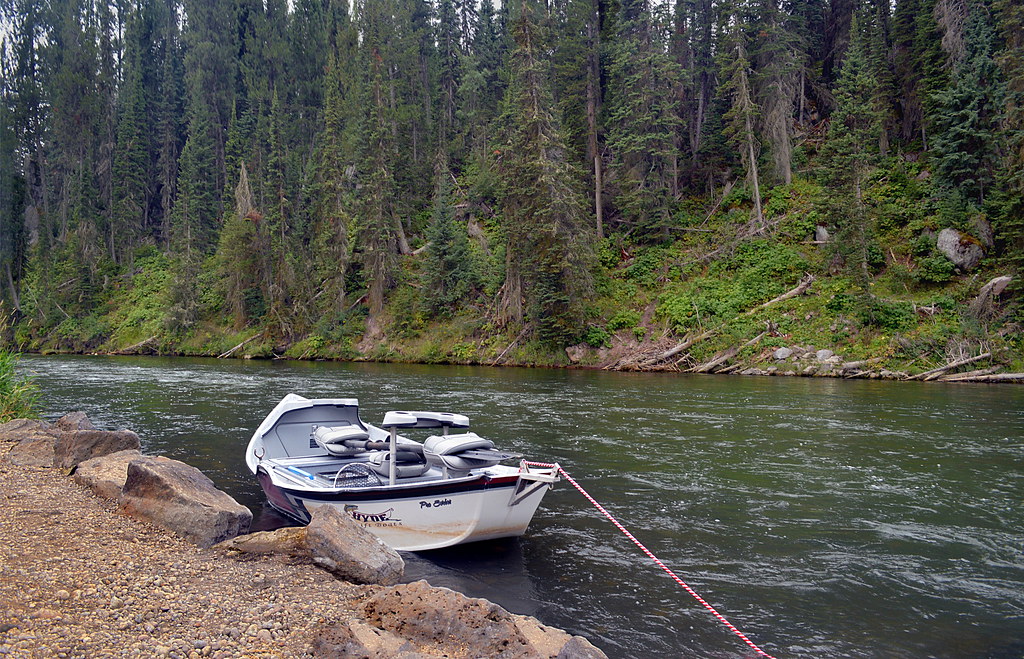
    .. The dams have tamed the roiling, canyon carving discharge of the two rivers into a pleasant stretch of river for floating in a drift boat  -- or canoe, or tube, or kayak.
    .. Should you not be a "nympher;" and should you fish with a guide, you will probably 'cherry pick' the riffles and fish in a most conservative manner. This will stab you some fish and lose you very few flies.
    VERY SMALL WORKS TOO
    .. If you're after the giants, and if you have flies to lose, you should probe the dark crevasses near large boulders. The giants are there. The crevasses hold deep dark secrets and enormous fish, as well as a full assortment flies - a veritable gold mine of history.
    .. Look for flows in the 800 to 900 cfs for a gentle day. Fish deep and fish slow. Lose flies and call it good. Go big when the big bugs are around. Go as small as size 18 when they are not there.
    .. You can even drown your favorite surface imitations - (after mashing them into nondescript wads,) and enjoy this little segment of the Snake River.
    .. We'll be back.
    -------
    WALLPAPER:   BUREAU OF RECLAMATION WATER HOUSE - 1939

    Friday, July 11, 2014

    Far And Away

    MORE THAN JUST RUMOR
    In A Remote Land
    gas up the trusty horse
    ON THE FORK
    -------
    .. Even here in our isolated village when there comes news of spectacular catching in a land far away and in wild lands to the west of us: we listen.
    .. Most parts of the HENRY'S FORK of the Snake River around Last Chance, in the foreign country of Idaho are producing catching stories of epic proportions.
    .. From reports of a flav hatch that blotted out the sun, to Green Drakes the size of hummingbirds, to caddis in numbers not seen in decades; the reports are staggering. The fish are gluttonous and the fishers exuberant.
    Trade Items
    .. With the recent ratcheting up of the flows through the Box Canyon even float trips have become nearly gentle and fishers are becoming catchers with little effort. Double droppers and streamers are taking the legendary Rainbow Trout of "THE BOX."
    .. We've put the bite on some of our inebriated neighbors and gathered together a war chest. It consists of enough trinkets, tackle, money, and maps to fuel an exploratory expedition to the wonders of the foreign country across the continental divide.
    .. Body armor, wormwood infusions, brewed hops, MRE's, and gossamer tippets are in the provisions.  The kit also includes a simultaneous translator device to enable us to communicate with the natives. There are even very foreign looking buglettes that are rumored to entice exotic and cagy foreign trout to the hand.
    .. Rivers wider than our driveway are not usually our choice for exploration, (yet we're stuck with way too many of them.) We've seen them fished. We've fished a few. We may have to suffer through another day of water where the far bank can't be reached with a cast from the near shore.
    .. Should the moon and planets align correctly and should the opportunity arise, we shall mount the extended visitation to verify the legends. After all, we're loath to have to be forced to return the extorted largess to the original donors.
    .. We'll report the results right here: should we be lucky enough to escape from the savages, over the hill, with our fingers and epidermis intact.
    -------
    WALLPAPER (Loaf 18):    SOURDOUGH SANDWICH BREAD

    Monday, November 05, 2012

    Au Revoir Yellowstone

    IT'S RESTING NOW
    Let The Fish Grow
    let the lies begin
    Looking Back: It Was A Very Fine Year.
    -------
    .. What a wonderful last week of the legal fishing season in Yellowstone National Park. The predicted blustery weather has died with a whimper and some thin clouds. Sunshine drenched the afternoons on most days and the bugs continued to hatch.
    .. As we look back over the year it seems that this was a year of many fish and healthy fish. Of course during this coming Winter the fish will grow in the retelling of tales in the dim pubs of town.
    .. There's still plenty of fishing in the neighborhood. Rest assured that we will manage to get to it and to the other not-quite-so-neighborly waters as well.
    .. Now that we've stopped saving our daylight it's time to make use of what little there is left. There are things to do, places to go, people to see. We're practicing using words like: Chetco, Umpqua, Grande Rond, Clearwater, and Snake. More to come.
    -------
    View Of The Chetco River From The Front Porch.

    Tuesday, September 08, 2009

    Slightly Off Center

    FALL FLIES FOR
    THE MADISON RIVER

    The Big-N-Ugly Box
    they work wonders
    -------

    .. Fall is when the trout in the Madison River are at their intellectual peak. They have seen flies from the four corners of the earth and rejected most of them. They have refused the offerings from both sage fishers and first-timers. They have figured out just what real food looks like.
    .. The fish are experimenting less and gobbling more. They've seen it all - almost. The flies below all work well for galling a trout on the Madison River. They work best in the Fall when a sack of groceries is on the mind of sex crazed trout. The combination of impending winter, (less food,) and the urgency of procreation, (more energy used,) join forces to make the following flies worthwhile - starting now.
    -------
    (All images are huge - just click on them.)
    .. Thunder Creek. When was the last time you heard someone recommend that old fossil? Who do you know that fishes it? They are either very good liars or just plain secretive. The trout in the Madison River haven't seen many of these. They usually eat the ones that they see. Fish it on the swing. Let it straighten out. Wait a little while then strip it in real fast. Old ways. This specimen, (rust, dead head cement and all took a nice fish at 7-mile bridge last October.)
    .. Original Olive Matuka. These are tied commercially but their sales are way off. Although infrequently used these days, there is probably one in your fly box. There may be several. They most probably are unused and forgotten. Drag one out and give it an honest try. The early morning is a good time for the darker ones. Dead drifted or stripped downstream in the undercuts may just surprise you.
    .. Chenille Matuka. Bright and boisterous, this variant is also tied commercially. It looks too gaudy for most "serious" fishers. It is a visual disaster in just about any fly box. It's not on the lips of the romantic poets of Yellowstone lore. Yet this variety is as good as or better than the original. The tail is splayed and provides nice action in the depths of dark pools. Sizes up to #4 and 4XL are not uncommonly found stuck in the noses of eager trout in the willows below the Highway 191 bridge.
    .. Bead Head Rubber Legs. There are a bazillion rubber legs flies. They have secret names as well as commercial names.
    .. They can be "Silli" - "Spooky" - "Madisoned" - "Fireholed" - and "Henry's Forked."
    .. We use several of them this time of year and all are just grand. This one may be the grandest of all. It gets down quick and is good for 'snap-casting' right above the big roll that ended with a baby splash just over your left shoulder. The combination of long hackle, wiggly legs, copper wire. and a prickly body are often irresistible when slow-drifted across the bottom of a dark pool at sunset.
    .. Guide's Secret Rubber Legs. Not a secret any more. Seven or eight years ago this pattern was hidden in dark places and fondled frequently in anticipation of Fall fishing. There are many variations of this fly: the chenille, the number of legs, the head and tail treatment, the size and hook. All seem to work just fine. There are now many commercial versions. Some of the local, (Cameron, Ennis, West Yellowstone,) versions are still proprietary. So be it.
    .. Hackle & Legs. Here's another rubber legs pattern that has been embellished with long widely spaced palmered hackle. This one can be made to float with enough goo, or what ever is your favorite flotant. On still, or slick, water in the light of a Gallatin Moon, (July, August, September,) The many dimples create little lenses that allow the light to be seen. Strikes can be explosive - especially after a slight twitch.
    .. The fly can also be drowned or fished on the swing in the film or down deep. It reminds us of an augmented Wooly Worm. It's good for a change of pace and is an excellent conversation piece.
    .. Woolly Worm. The poor thing: fallen into disuse and disgrace. Often mentioned in the same sentence as the San Juan Worm. The Fall sizes and variations are not within the traditional range for this old sweetheart, (how many do you have?) Sizes in the 2 - 6 range are not uncommon. Long hooks are used by the neighbors. Red buck-tail is used for an afterburner. Very long, (for hook size,) hackle is the norm for this time of year. Traditional yellow and black are frequently the choice for the area around the Barns Holes and the Local Hole. More often, the last couple of years has seen hot orange or bright rust being chosen for the big water just above the estuary on the Madison River.
    .. Pheasant & Blue. This streamer is a staple along the Washougal River in Washington and on the upper Clearwater River in Idaho. The pheasant rump feathers are popular in both steelhead and salmon fly patterns. Fishers on the South Fork of the Snake River in both Idaho and Wyoming have used this pattern for a couple of decades to take large migratory cutthroat trout. This pattern is now finding it's way into secret stashes of some of our neighbors. We've not used it but they swear by it - and at it.
    .. Brindle & Hen. This popular fly from Northern California locations around Hoopa, Eureka, and Salyer has been modernized by the recent explosion of color in chenille. Similar in form and function to the classic Brindle Bug this fly is not just another pretty face. Tied with a heavy wire under-body it bounces through deep riffles with undulating sex appeal and is hard to resist by submarines parked in the dark spots during mid-day. This is a useful probing fly when tied with no underwire support and the action is leech or eel like. Just the groceries a fresh-run fish is looking for.
    .. Bead Head Glitter Nymph. This monstrous cousin to the standard pheasant tail nymph is persistent in the repertory of the big-fish catchers in the neighborhood. It's easy to tie in sizes 4 - 8 and makes an excellent fly for the low clouds and bright overcast days of late September and October. It has nearly replaced the Casual Dress in our box and we don't regret it. Bleached goose biots are becoming rare these days. White will work just fine - or do some yourself.
    .. Sinking Hopper. It's just about time for the sheep to call it quits on their hopper box. The feather merchants have run low on their stash and will soon begin touting the flies of fall. Grasshoppers in the high country continue to grow and molt through the first couple of weeks in October. A hard frost will "knock 'em down." A couple of warm days, (even after snow,) will kick some life into them. Drowned, this fly is a nearly irresistible morsel for the big resident trout and a rare treat for the lake run fish of the Madison River.
    .. Many of our strangest neighbors use this as a dropper behind a big streamer such as a Woolly Bugger, Egg-sucking Leech, Chamois Leech, or a Brindle & Hen. Common practice is to soak the little dickens in water for a day or two and let the river do your shopping for you. Foam patterns are just too hard to sink - they can be retired now.
    .. Dark Spruce Fly. This classic has persisted despite the hawking of "more modern" flies. There are many variants and they seem to be quietly proliferating. We prefer ours tied a bit on the sparse side and choose to use a barred furnace hackle tip of a mahogany color rather than the traditional golden badger hackle.
    .. This pattern is old, (1918 - 1919,) and was originally called the Godfrey Special. It was a premier sea-run cutthroat pattern for over half a century. It is still seen along the Madison River, and steelhead streams most everywhere. This is just the tonic for jaded trout around Baker's Hole and the Barns Holes.
    .. Furnace & Red. This fly has been a staple for our Fall and Winter fishing since sometime in the late 60's. A couple of dozen were a gift from a fly fisher in Pocatello, Idaho. He may have "invented" it.
    .. The name was roughly translated as "BOB'S FLY" - Google shows nothing quite like it by that name. It's a dark fly that is sometimes stripped cross-current at night or in the twilight. It's caught a few big fish. A few of the ancient neighbors here and in I.F. use a similar fly - with different names. (The eyes are Herter's NOS. We have zillions of them and used to think they were important - works just as good without them.)
    .. The Little Brown Trout. Dear to the hearts of Montanan's that love our cutthroats. There is a satisfying surge of glee, (it arises somewhere between the epitome and id,) when one of these little flies gets eaten. This old pattern is seen in most fly boxes and is only occasionally used. It is special only in the hearts and minds of ancient neighbors that remember what a glorious bit of water the Snake River was without the scourge of the invasive Brown's. Fish it like the little streamer that it is. Shallow riffles, deep undercut banks, and deep slicks are it's prime hunting ground. Even the Browns will eat it.
    .. Stonefly Nymph. They live here. They get dislodged. They float around in the water column and get eaten all year long. Of course they are a Springtime religion, but the trout will eat one that's floating by. Often the older neighbors tell us to "hit 'em in the nose." That's good advice if you know where the noses are.
    .. The mundane task of systematically covering a run in the Fall is a bit tedious. It is also rewarding when using any of the many stonefly imitations. Like a dog with a bone, the fish grab it, shake it, and hold onto it with a fierceness like unto a virgin prom queen in the back of an S.U.V.
    -------
    .. Baker's Hole Bugger. Straight from Blue Ribbon Flies & Whiskey Creek Fishing comes a fly designed specifically for the water around Baker's Hole. It's a fly that has been "making the rounds" for a few years and shows some staying power. Although supposedly designed "for Brown Trout" the fly is just fine for pricking hungry trout of any stripe.
    .. A couple of the neighbors are aficionados of this fly and have already shortened it's name to "Baker's Bugger." They fish it all year long. The fly uses standard Brindle Bug chenille and a two toned tail similar to the Brindle and Hen. These long-tailed buggers have been getting more attention during the last decade. Probably a good reason for that.
    -------
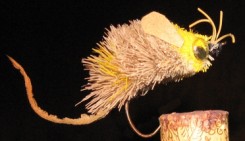
    .. P.S. Don't forget your Mouse. Fishing in the park is open until 10:00 PM.
    Wednesday, March 04, 2009

    Safari To Jackson

    GET AN 11-WEIGHT
    Hire A Local Guide
    tell nobody we went
    get famous
    .. The secret is out. Giant Fish exist in the Snake River near Hog's Head Island, south of Jackson, Wyoming.
    .. We're trading in our collection of trout rods for some more substantial gear and planning a safari to the nether regions of Wyoming.
    .. It seems that a new guiding industry has sprung up in the region based on the possibility of catching Atlantic Salmon that lurk in the depths of this fabled river.
    .. One of the more famous guides is an old Africa hand and experienced in those things that make for an excellent safari.
    .. He is renowned for finding women, congenial watering holes, game of all sorts, and having a good time. It is also rumored that he once caught a cold fish.
    .. We've already procured our safari outfit from the local outfitters and feel that we cut a fine figure of the salmon hunting genre.
    .. We plan to nose around the local pubs for information about the location and methods for taking this monstrous invasive species.
    .. Many people doubt that the Atlantic Salmon exists in the Snake River and believe that the sightings and captures are of it's cousin the Kokanee Salmon, that do reside in the river.
    .. A little known fact, however, is that Atlantic Salmon were, in reality, introduced into Yellowstone Lake in the early 1900's.
    .. Most trout fishers and biologists poo-poo the thought that the fish could have gotten out of Yellowstone Lake and survived in the Snake River.
    .. On the other hand, a small cult of fishers has been spawned and they are currently stalking the river banks and the shadowed coves in an attempt to capture this elusive prize.
    .. When the capture happens, you'll have to take our word for it, because we believe in strict 'catch and release' of all salmonids; invasive or not.
    .. On very rare occasions the veracity of our reports has been questioned. However, in this instance, independent confirmation is a precursor to our report. Read all about it in the Planet Jackson Hole Online article HERE.
    -------
    FISH ON!

    Monday, January 12, 2009

    What Would Woody Say ?

    A BIT OF INFORMATION
    Yes Mable
    Montana Drains
    Both Ways

    $$$$$$$$$ vs. FISH
    .. The salmon of the Columbia River are getting fingerprinted, [LINK,] a judge refuses to hear a case brought by Oregon, [LINK,] massive flooding is impacting young salmon survival, [LINK,] Canadians agree to catch fewer Columbia River Salmon, [LINK,] and light rail is coming to Vancouver, [LINK.]
    .. The perspective of resource management is culture-bound and temporally constrained by history. Time and place dictate concerns. Are introduced carp a resource or a curse? Is it 1820, or1920, or 2020?
    .. Are the trout above Firehole Falls an invasive species? Boon or bane? 1890 or 1990 or 2030? Is the Madison River a better river because of Hebgen Dam? 1925 or 2005, or 2035?
    .. Just how do we address our resources? Do we love dams and tailwaters for the right reasons? Do we hate dams and tailwaters for the wrong reasons?
    .. In the spring of 1941, on the cusp of the Great Depression and Pearl Harbor, a 28 year old, unemployed Dust Bowl balladeer, Woodrow Wilson Guthrie took a one month, temporary job with the U.S. Department of the Interior's Bonneville Power Administration (BPA) on the Columbia River.
    .. The BPA needed a folksinger to promote the benefits of building dams to produce cheap electricity. Guthrie, and his wife and 3 kids needed the paycheck. He wrote 26 songs in 30 days - classics like Roll on Columbia and Pastures of Plenty.
    ..
    ..
    .. Below is the contemporary take on the river situation some 67 years later. What would Woody say today?
    ..

    -------
    .. Not to stretch the analogy too far, but - Montana, today is growing rapidly and stressing the infrastructure required for the contemporary "plush life." The similarity to the Columbia Basin 'boom' of the 50's and 60's is striking. And, yes, Mable, there are parts of Montana in the Columbia Basin.
    .. Our trout waters are diminishing under the onslaught of expansion, rural gentrification, visitation, diversion, and drought. We desperately need a clear spokesperson for the habitat that nurtures our fish. A spokesperson with a bell-clear voice willing to sing the song before it's too late.
    .. Are feather merchants the contemporary balladeers of today's rivers? Do we love fishing, or fish, or rivers, or resources? Time will tell.
    -------
    P.S. Did you know that there is a dam on the Firehole River? Maybe we should make it bigger! Could it generate some electricity for the new Visitors Center? Perhaps a lake and a new tailwater fishery? Who's to say?

    Tuesday, December 02, 2008

    Sunday, March 23, 2008

    It's Getting Worse

    CUTTHROAT TROUT
    ARE WHIRLING AWAY

    Malady Spreading Like, - well - Whirling Disease
    watch them go
    .. The Denver Post is just the latest in a long line of newspapers to run a story about the disappearing Cutthroat Trout of Yellowstone. Both the Yellowstone Cutthroat and the West Slope Cutthroat are in trouble.
    .. Whirling disease is the culprit, in the "Troubled Waters" of Yellowstone, cited by Charlie Meyers in his note about the declining numbers of the trout.
    .. In 1995 the New York Times and Peter Kaminsky brought the situation to national attention in their article "Trouble In Paradise." Mike Stark of the Billings Gazette has been diligently writing the same information in articles since 2004, (1, 2.) The Greater Yellowstone Coalition has been involved in the effort to save the species since 2005. The Montana Department of Fish Wildlife And Parks has been acutely aware of the problem since 2001.
    .. These natives are disappearing from the regions waters for a variety of reasons, and Whirling disease is not the least of them. Studies have shown the importance of these fish to the ecosystem, and their reduced numbers are alarming.
    .. The growing concern stems from the fact that the spawning streams are now infected and the trout are being wiped out in increasing numbers at an increasingly early age. The spawning streams of the Yellowstone River in Paradise Valley and those of the South Fork of the Snake River are now breeding fewer Yellowstone Cutthroats and more parasites.
    .. This two year old map shows the known distribution of New Zealand Mud Snails in and around Yellowstone National Park. This is almost exactly the same as the known distribution of whirling disease. As you can see the dots follow the Yellowstone River into the Paradise Valley. Here, about 2/3 of the spawning tributaries have shown infected populations.
    .. The documentation shows that both are rapidly spreading and reducing the fish population to dangerously low levels.
    .. There are a couple of strains of Rainbow Trout, resistant to the disease, that have been developed by fisheries scientists that may be useful in stemming the tide of the disease in this species of trout. However, there are no known Cutthroat Trout that are resistant to whirling disease.
    .. In addition to whirling disease the native Yellowstone Cutthroats are being hybridized out of existence in most waters in the Yellowstone ecosystem. (See: Keeley for the work in Idaho, 1, 2, 3, 4.)
    .. The National Park Service advises each fisher on Slough Creek to kill up to five (5) Rainbow Trout that they catch there: provided they can tell the difference.
    -------
    Money Quotes: NPS

    To reduce competition, predation, and hybridization stress on native fishes, Yellowstone has increased harvest limits of rainbow and brown trout in waters where they co-exist with cutthroat trout and fluvial arctic grayling.

    In cutthroat trout waters where rainbow trout have been introduced, either by intentional, historic stocking or by invasion from a downstream source, the result has been a serious degradation of the cutthroat trout population through interbreeding of the two species.

    Harvest of nonnative trout is allowed, and in some cases required, in many park waters.
    .. Of course the unthinking fly fisher believes that catch-and-release is a panacea for all situations, in all places, and at all times. and has refused to do this in any meaningful way on Slough Creek.
    .. You should hear the patter in the local fly shops. "Hell one trout's as good as the next, and those cutts are lazy fish, anyway." "I'd rather kill a Cuttthroat than a Brown any day." "There's no difference between a Cutbow, a Rainbow, and a Cutthroat." and so it goes.
    .. In addition to New Zealand Mud Snails, Lake Trout, Whirling Disease, and Hybridization it might be that the most dangerous invasive species, for the native Yellowstone Cutthroat, is Homo Sapiens. Hardly sapient in this instance.
    .. The long history of our manipulation of the fisheries around us, gives pause to the thought that we can or should do anything now. Yet the fish of the Thorofare may be the next to go the way of the downstream populations.
    .. These gems are wild, wily, and cagey. They are prey for bears, coyotes, pelicans, eagles, hawks, wolves, and man, for starters. It would be a shame to see them disappear as both a sport fish and a member of the food chain.
    .. As the hint of Spring brings to mind fishing in Yellowstone, it also reminds us that it is the informed fisher that enjoys the pastime the most. The history of fish species in Yellowstone has informed the park's managers in their drafting of regulations. It behooves the fisher to be at least as well informed as the managers.
    -------
    .. There are much better resources on-line about Yellowstone Fishing than you get in the little pamphlet that comes with your fishing permit. The following are exceptionally well written and should be read and understood before fishing in Yellowstone.
    .. And, again, this year there are changes. We post this now, AND, let you know that we will post it again as fishing-time draws near.
    .. Yellowstone Fishing Regulations (PDF)
    .. Yellowstone Fishing Season Dates And Regulations
    .. Yellowstone Fishing And Fisheries Science
    .. Yellowstone Park Advice To Anglers
    .. Troubled Waters, Yellowstone Video About Invasive Species
    .. What's On Your Line? Yellowstone Video
    .. Fish Identification Tools - Poster Downloads (PDF)
    .. Yellowstone Fish Distribution Maps
    -------
    NPS RECOMMENDED LINKS

    Fishing in Yellowstone - YNP Site
    Invasive Threats to Yellowstone Fisheries - YNP Site
    Whirling Disease Initiative - Montana State University Site
    Stop Aquatic Hitchhikers - A public awareness campaign, and a program of the U.S. Fish and Wildlife Service and the U.S. Coast Guard.
    National Invasive Species Information Center - US Department of Agriculture Site
    Aquatic Nuisance Species - US Environmental Protection Agency Site, Region 8
    Montana University System Water Center - Montana State University Site
    Aquatic Nuisance Species Task Force - Unites States Federal Aquatic Nuisance Species Task Force Site
    Whirling Disease Information - Whirling Disease Foundation Site
    New Zealand Mudsnail Information - Montana State University Site
    Aquatic Invasive Species - Wisconsin State Environmental Resource Center Site
    National Aquatic Nuisance Species Clearinghouse - New York Sea Grant Site
    ---------
    .. The weekend was busy and we had barely time to fish or to visit THE HORSE'S MOUTH. But we did both. One of the cutest wahines ever was posted on Good Friday. And, just in case you missed the week before we reproduce below one of the most daring of all Friday wahines.

    Friday, February 29, 2008

    Before The Storm

    NEIGHBORHOOD FISHING PICKS UP
    Anchor Ice Lifting
    shameful behavior
    random stuff
    .. The trail through the snow to the Madison River has reached bare ground in the vicinity of Campfire Lodge: brave soles have connected the post-holes at the Hebgen Tailwater, the anchor ice is rapidly disappearing along the Gallatin River in it's lower canyon reaches, and, (parenthetically,) fish have already arrived at the Henry's Lake Hatchery on the Snake River.
    .. As water creeps over the ice on Hebgen Lake, and the thrummers begin to worry about slush and cracking bringing an end to a very hot ice fishing season, local fishing and canyon fishing is on the upswing. "Buggy" flies and slow drifts are beginning to produce results among the pre-spawn fish on the Madison River below Hebgen Dam.
    .. This is the time of year that the Yellowstone Winter Grub shines. The fly looks like a giant Prince Nymph, casts like a bowling ball, fishes like a spark plug, and catches any fish with at least one eye open - it works wonders. Tied in sizes from 4 to 12 it is an old fly with just local fans, not a secret - just underused. Right now a size 6 or 8 is working good.
    .. The trail to the lower end of Quake Lake is still a snowy snake with icy scales. The fishable water is just now appearing and only the brave and young should attempt this type of fishing: risk/reward plays a part here.
    .. Another fly that the neighbors are using is the HELLIFIKNOW. This bit of flash in the early morning darkness is just the ticket for those fish that don't yet know that the fisher folk are prowling. It is fished as much as a novelty as it is a working fly. Often it is the fly of first and last resort . . . we have several sizes and use it in the backwater eddies - it's visible for a ways and provides some measure of security for our cold fingers in the morning. Sizes 8 - 10 are the choice right now.
    .. Starting around Red Cliff and going down stream the Gallatin River is providing good action in the afternoon. This is the time of year when the anchor ice has lifted and morsels from the deep are available to the fish. Nymph fishers usually tie on their favorite double and pound the depths of the deeper runs.
    .. Our current double is a Yellowstone Spruce Fly with a Yellowstone Badger tied to the bend of it's hook with a 12" leader. This rig is less used today than in the past; sad if you want to catch fish -- glad if you can't cast a whirling dervish.
    .. If you haven't seen it already, click on over to The Trout Underground and see how shameful behavior is running along the fine line between humor and slander. Poor Tom has enough on his plate without having to deal with marginal poop. Humor????
    .. The new format and focus at THE HORSES MOUTH appears to be in it's final stages of completion. It is lean, mean, and focused . . . informative and always a pleasure to browse. Two recent posts have gotten much review at our morning biscuits and gravy fest: MAS WAHINES SURFING & POISSONS LE VENDRETI - love the linguistic juxtaposition.
    .. Another revamp has seemed to reached it's zenith over at FLYTIMES. You'll be redirected if you use the old address. They are now at: http://www.theflyfishingblog.com/. Same good stuff but now a real DOT COM! We'd wondered about the paucity of posting and now we know.
    .. FLYFISHMAGAZINE lets us know that the times are truly changing as more and more fly fishers take up the challenge of "Competitive Angling." How very American!
    .. If you are still young and firm enough to wear a T-Shirt, it's worth your while to visit snorgTees.com. They have some shirts a bit out of the ordinary and show the kind of creativity that we wish we had. The shirts are grand, and the pictures are just as good. If you're the creative sort send them a design - they are always looking for Tee's with a bit of class.
    .. As if we didn't already know it, Microsoft's latest operating system is a resource hog of the first order. Now there is a formal class action suit against them for certifying minimal PC's as "VISTA Capable." Even Microsoft employees got stung and ended up with $2,100 email machines.
    .. Speaking of Windows, there is now a complete musical composition using only the sounds from Windows 98 and Windows XP. It won't seduce many wimmen at the bar, nor will it conjure fish from the depths . . . it is catchy though.
    CLICK HERE FOR FULL SCREEN APPRECIATION
    .. Well it's time for biscuits and gravy, there's a storm coming, fishing is on the agenda for the day, and of course there's some lies to be told before it all.