• PARTNER: PROTECT YOUR WATERS
  • Go To: THE FLIES OF YELLOWSTONE
  • Go To: YELLOWSTONE FISHING WEATHER
  • Go To: YELLOWSTONE FLY FISHING MAPS
  • Visit: Moldy Chum
  • Visit: The Horse's Mouth
  • Visit: Chi Wulff
  • Visit: Parks' Fly Shop
  • Showing posts with label Feather Duster. Show all posts
    Showing posts with label Feather Duster. Show all posts

    Thursday, April 18, 2019

    Hot Right Now

    OLDIES
    But Goodies
    in a trout's eye
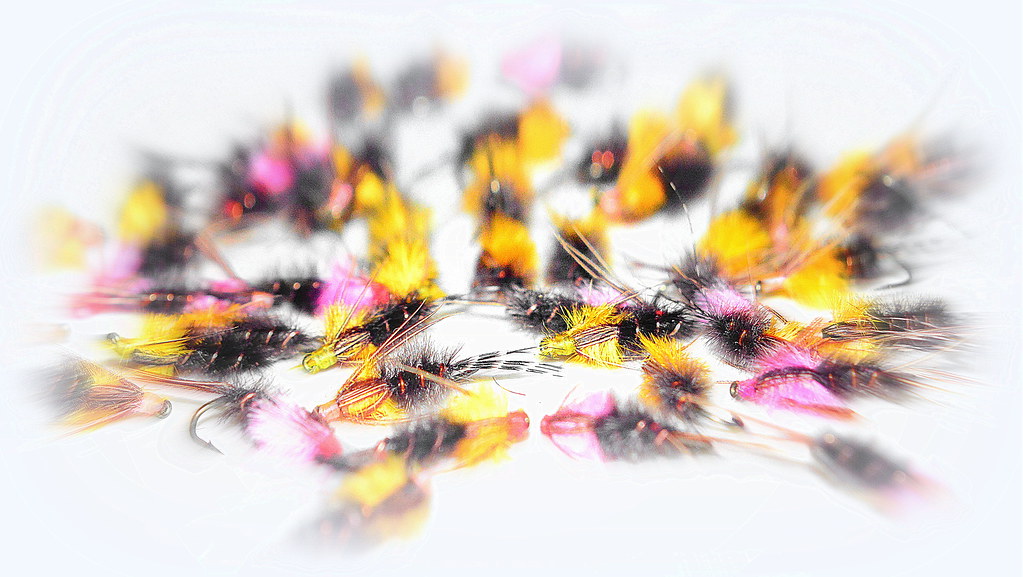
    WALLPAPER:  BUNCH O' DUSTERS
    -------  
    .. A couple of the neighbor kids are busy replenishing their supplies of Feather Dusters.
    .. It's an old favorite in our neighborhood. It's not touted by the counter help at the local feather merchants - probably no cheap commercial source.
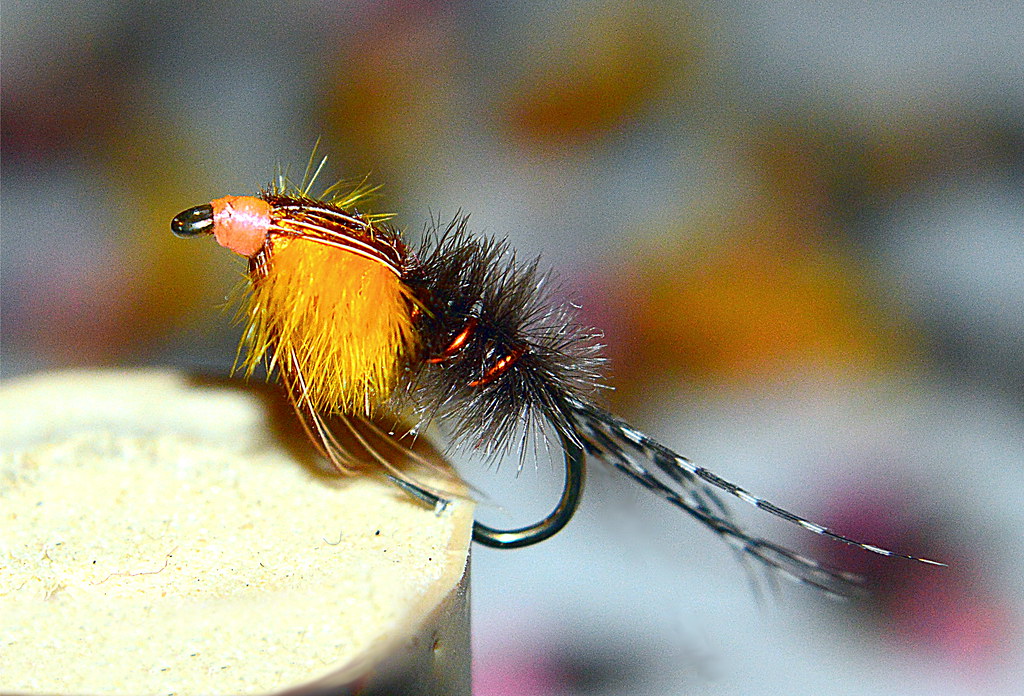
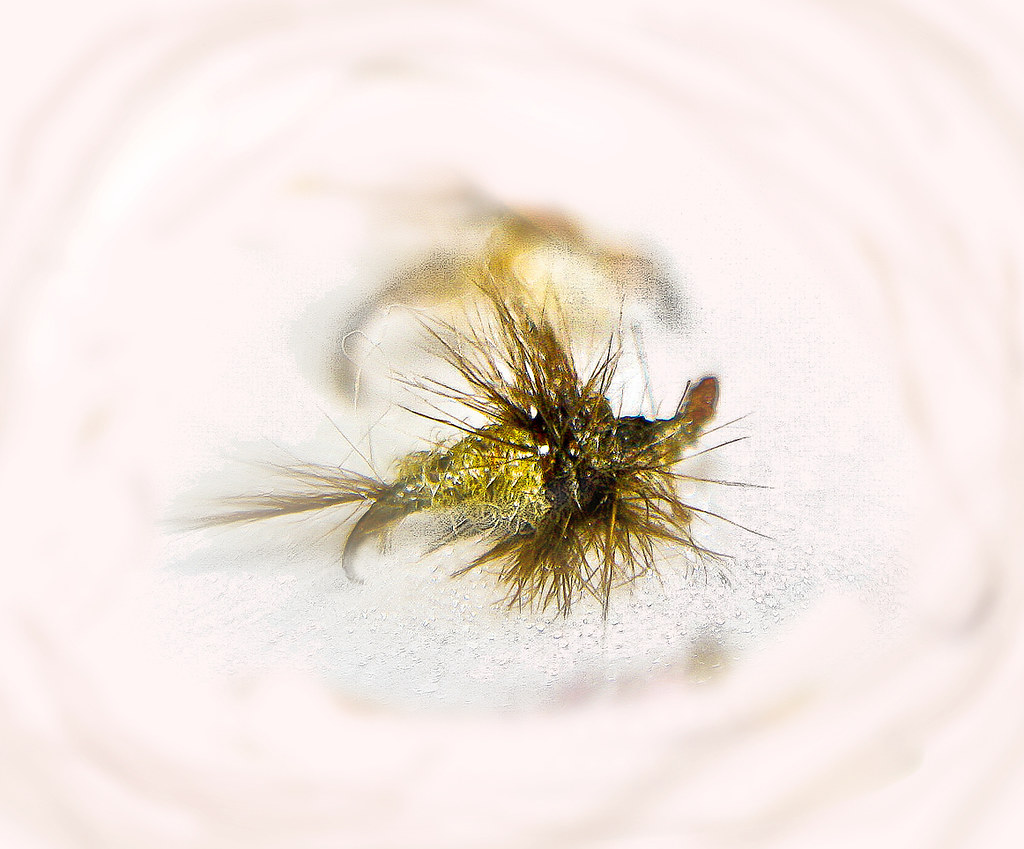
    ORIGINAL FEATHER DUSTER
    .. Ever since Wally Eagle started tying them they have been in all the neighborhood fly boxes, (STORY HERE [scroll down].)
    .. The original pattern was made from a feather duster that Wally used in the fly shop. It's colors were constrained by the ostrich feathers in that one item.
    PINK FEATHER DUSTER
    .. Of course, over time, our local mob has modified the little darling and we now have a wide variety of variants.
    .. As the kids tie, they try. Right now the pink variant is red pink hot. Call it an egg. Call it an attractor. Call it what you wish: it's doing a job in the local waters.
    .. The yellow vatiant will come into it's own in a very short time and is often used as a dropper behind the early caddis hatch patterns (late mom's day this year.)
    SULFUR FEATHER DUSTER
    .. Large pink ones are often dropped early below a stonefly pattern: even below giant Salmonfly patterns.
    .. We seldom mention this pattern because it is often taken for granted as 'in the box.'
    .. But, as right now, when it is bending rods, twirling reels and, clicking clickers - we let you in on the action.
    .. It is being used at the edge of the ice and along the rip rap on Hebgen Reservoir. It is scoring very well in the spawning areas Between The Lakes.
    RUBBER BAND CADDIS
    .. Even the kids with the sled have reported exceptional action at the South Fork Estuary.
    .. Some success was also noted at the frozen springs near the mouth of Grayling Creek, This is tough to get to but highly productive this time of year.
    .. You can get fairly easy access if you enter at the old Grayling Creek Post Office Site.
    GRAYLING CREEK ACCESS
    .. You can park at the turn out and take the trail by the NO TRESPASSING sign.
    .. The cattail/willow marsh is still partially frozen and you should not step in any open spaces.
    .. Drop a feather duster below something that floats very good and let the gentle currents from under the ice carry it to the fish.
    -----  
    .. Tomorrow is GOOD FRIDAY. Even though Germany forbids dancing and horse racing we should not worry. The West Entrance of YELLOWSTONE NATIONAL PARK will open it's gates.
    .. It looks to be a postcard day. Bright blue skies with billowing white clouds will give visitors many opportunities for "THAT PHOTO."
    .. It should be 60°F by early afternoon - and there is a predicted high of 65°F around 5:00 or 6:00 PM. We ordered it up just for y'all.
    -----  
    .. We should spend the rest of the day in productive chore elimination routines. It is Spring and there is much to do. However a mosey through town and to the gossip spots is in order. Besides that, there are some groceries to gather up.
    -------  

    WALLPAPER: CHICKEN FRIED STEAK

    WALLPAPER: COUNTRY FRIED STEAK


    Monday, June 16, 2014

    Variations On A Theme

    NO BIG SECRET
    Colors Come And Go
    must be the material
    ORIGINAL FEATHER DUSTER
    -------
    .. George Edward Mackenzie Skues has a Facebook Page, HERE. It's worth a look. So is fishing with a fly that can't be seen.
    .. Although genteel conversations today reflect the controversy that erupted on the chalk streams of England over a century ago, there is a growing schism in the mindset of some fly fishers, (for a precis of the man and the controversy check THIS, OR THIS.) [[Should you need a copy of the book there is one for sale at AMAZON.]]
    WHITE THORAX FEATHER DUSTER
    .. We are partial to catching fish, no matter how, (within some limits.) Some folks are fixated on technique rather than the catching. More power to them, we like the catching.
    .. Most often, in the life of a trout, the fish is in the depths of the water. They forage and nibble and gulp up food where it is most reliably present. Most often that's where we place our flies.
    .. During this time in the early season we are partial to a local invention: the Feather Duster. We go through a hundred or so of these flies each year. We fish them where the fish are: down deep and in the snarls of weeds, twigs, logs, boulders, etc. They catch a lot of fish and more other stuff.
    PINK AND YELLOW FEATHER DUSTERS
    .. With the feigned insight of our expert neighbors we select the color variation of the fly that suits our whimsical mood. Eventually we catch a fish or two.
    .. It probably has as much to do with the fly as with how we fish it - perhaps more. It might even have to do with the fact that we fish the fly more often than others.
    .. Color variations and bead heads have cropped up over the years. They all work eventually.
    .. Lately we've had our head stuck on a couple of colors: pink and yellow. There does not seem to be, to our feeble mind, much difference in the effectiveness of either color. Obviously we'll need more research in this area. More twigs, snarls, weeds and rocks are in our future.
    .. Right now we're fishing the yellow. We've just finished with the pink ones, for the moment. Soon we'll be using up our stash of originals. The merry go round never ceases.
    .. Some of our local feather merchants carry Feather Duster flies. Some shops have given them up for their own latest and greatest creations.
    .. The interesting thing about different fly varieties is that they all work and they all are gobbled up by visitors seeking something special.
    .. We've run out of money for the latest and greatest.
    -------
    WALLPAPER:  YELLOW THORAX FEATHER DUSTER
    -------
    .. This old fly gained surprising popularity soon after Bob Bates described it in the Outdoor Press, (August 26, 1993). It was developed in the early 70's and has garnered a following of dedicated nymph fishermen. The original article is hard to find, so we have reproduced it here.
    ***
     "WALLY'S FEATHER DUSTER" 
    .. Eagle's Store in West Yellowstone, MT is just a block and a half from [the] Yellowstone National park west entrance. They stock a lot of things that you need but can't find in the gift-shop-type stores around West Yellowstone. As always it was the fly shop section that interested me most. Beside a normal collection of fishing paraphernalia and good information, they had a set of pictures showing how to build a Feather Duster.
    .. The name was bestowed because Wally Eagle, who developed it in the early 70's, used ostrich herl from a feather duster for early copies. (Please do not confuse it with similarly named flies, such as the English dry pattern.) Wally's Feather Duster catches a lot of fish around West Yellowstone and should prove equally successful elsewhere in our northwestern region. Wally provided additional tying details and fishing techniques and a sample fly to photograph.
    .. Wally recommends fishing it dead drift with a yarn strike indicator. Any strange movement of the indicator might mean a strike so tighten up a little. You'll know instantly if it is a fish or the bottom. To place an indicator, simply tie an overhand knot in the leader and put a piece of yarn inside the loop. Carry a safety pin to open the knot and change it's position.
    .. For fishing the Madison River, place your indicator about 3 - 4 feet above the fly and add a split shot, if needed. On spring creeks, place a sheep's wool indicator only 18 - 20 inches above the fly. The sheep's wool indicator should be as small as possible. Wally uses a chartreuse indicator for good light conditions, but finds it hard to see in some conditions. He recommends using pink or green indicators in bad light conditions.
    -- Hook: Mustad 9672, 10 - 18
    -- Thread: Burnt orange 3.0
    -- Weight: Lead wire
    -- Under body: Gray wool
    -- Tail: Pheasant tail fibers
    -- Rib: Copper wire
    -- Body and thorax: Ostrich herl, dark gray
    -- Wing case: Pheasant tail fibers
    .. Put about five wraps of lead wire around the shank where the thorax will be. Just keep it back from the eye three or four eye widths, so you will have plenty of room for other materials. Use a lead wire that is about equal to the hook wire diameter. Attach your tying thread and wrap over the the lead a couple of times to secure it. Bring the tying thread rearward and attach a strand of wool. Wrap the wool to make an under body for the ostrich herl and shape the thorax; the wool also makes a soft base for the pheasant tail fibers. As with the lead wire, leave plenty of room for a head. .
    . Use 6 or so pheasant tail fibers for the tail, attach them at the bend and make the tail about a gap width long. Also just in front of the bend secure a copper wire and 5 or 6 ostrich herls. Attach the herls by the tips if you want to taper the body and by the butts if you want a full body. Carry herls forward to mid shank or 2/5ths point depending on if you want a longer or shorter thorax, secure and trim. Counter wind copper wire ribbing, secure and trim.
    .. Then right in front of body, tie in 8 to 10 pheasant tail fibers with the butts forward. Leave about a shank length of tips facing rearward. Wrap over butts, bring thread back to tie in point, fold butts back and secure. Attach several ostrich herls for thorax, wrap thread forward, wrap herls forward, secure and trim. Be sure to leave plenty of space for the head. Bring pheasant tail butts forward. secure and trim. Pull tips forward, secure with one or two thread wraps and bend tips back on each side for legs. Legs should extend along the body, ending short of the point. If there are too many legs just trim off a few. Finish the head with a whip finish. Wally doesn't use thread cement because he feels that it lets the Turle knot slip.
    .. Pheasant tail is fairly delicate and breaks when big fish chew on it. Extra layers on Wally's Feather Duster wing case give you the opportunity to clip off broken fibers and still have a neat looking wing case. .. Note: on flies 16 and smaller, Wally's tiers might use partridge instead of pheasant tail for tail, wing case, and legs.

    Tuesday, August 20, 2013

    A Commercial Ploy ?

    LET'S TRY THIS
    It'll Make A Lot Of Money
    who knows the difference ?
    Size 14 hook. Same pattern? Three sizes? Sell 'em, who cares?
    -------
    .. Fly patterns are funny things. Depending on the tyer and the fisher and the fish - some are just right and others are all wrong.
    Light Color Variety -  Original Pattern
    .. Through time, (and for various reasons,) the recipe for any pattern can change: the skill of the tyer, the available materials, the experience with fishing different patterns, and countless other factors enter into the equation.
    .. In time the resulting flies can come to be so divergent from the originals that they are, in fact, something entirely different.
    Yellow Variety by Jeff Kennedy
    .. One variable, in this pecuniary and avaricious time, is the economic factor. "Let's sell it and we'll get rich."
    .. Profit is a common reason for innovation and change among feather merchants. After all, they are in "business" to make "money."
    .. 'Latest and Greatest' is a surefire appeal to fly fishers of the affluent and egotistical sort. 'New and Different' comes in a very close second.
    .. Well, sports fans, you can now get the "Newest and Latest, and Greatest, and Most Different Feather Duster of all time!"
    Original by Wally Eagle
    .. It's being tied by hungry folks and sold in local feather merchant bins.
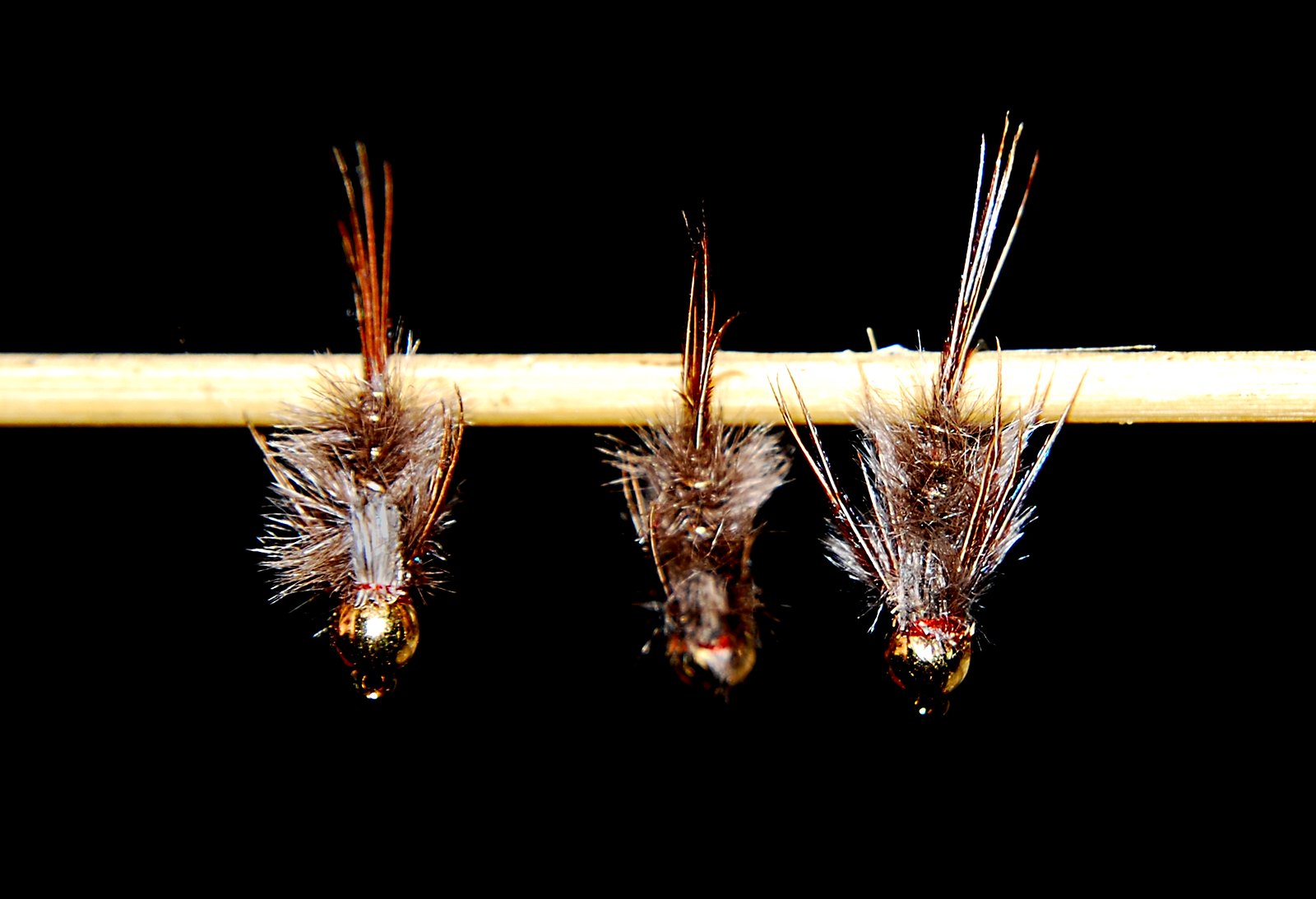
    .. It has a bead head, (WOWIE!,) is tied with orange thread, (YIPPEE SHIT!,) the ribbing is obscured by the dense plumage, (SUBTLE, DONTCHYAKNOW!,) it's silhouette is highly variable, (IF AT FIRST . . .,) the pheasant tail caripace, (thorax cover, pronotum, mesonotum, or whatever,) is of just three or four fibres, (ECONOMY FOR SURE!,) various size flies occur on the same size hook in the bins, (EXPEDITIOUS CAPRICE!,) and the seasonal help has told us that they are "Killer Flies." They then asked us what pattern they were!
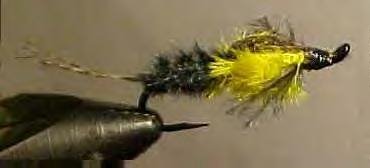
    Yellow Variety. By The Neighbor Kids.
    .. This is not a rant against innovation. In fact we think that a Bead Head Feather Duster is a good idea. Wish we'd thought of it first.
    .. But the idea that putting a bead head on a highly variable, nondescript, (fluffy and fuzzy,) fly, no matter what the recipe, (if poorly tied, and sold as a killer fly,) borders on the criminal. Ah America.
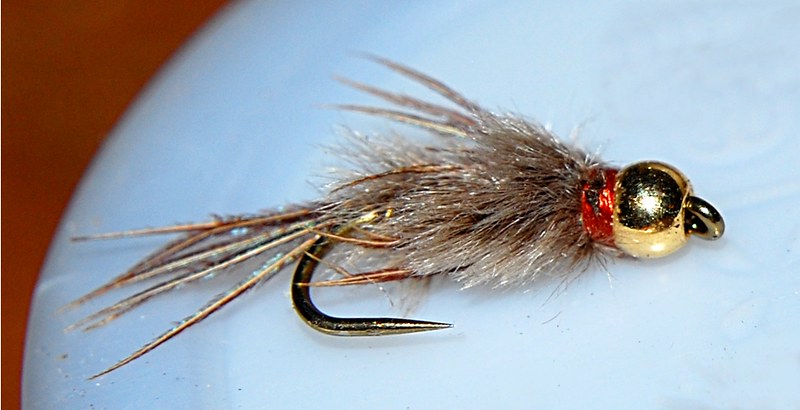
    Gold Ribbed Hare's Ear
    .. We've fished feather duster patterns for decades. The ones that work the best are the ones that are shaped like the original.
    .. The rule of thirds seems to hold here. Forward third a bit greater in diameter and  fuzzy. Middle third smaller in diameter and less fuzzy, (clearly segmented.) Final third a substantial tail that can be individuated if necessary
    Lovely Thirds
    .. The size, shape, proportions, and general appearance of successful Feather Duster flies is very similar to the Gold Ribbed Hare's Ear fly, (which has made a successful transformation to bead heads.)
    .. In fact most nymphoidal imitations seem to follow the proportions of insects - by-and-large. Whether this is a function of tradition or considered imitation is open to debate - but there you have it.

    ½ & ½  Good Idea. What is it?

    .. We're usually not too anal about exactitude in fly patterns; yet, if there is so much difference that the patterns in a single bin don't seem to be the same we get a bit antsy.
    .. Some color varieties work better at some times and not at others. The key factors for this particular pattern to gall fish with regularity seem to be size, proportions, silhouette, and presentation.
    At least a dozen fish lurk here - probably more.
    .. Nothing too scientific here but: over the weekend, (on the Gallatin River in Yellowstone National Park,) we fished some commercial bead heads in tandem with the traditional ones.
    .. In about an hour and a half we caught one fish on the bead head fly and better than 12 on the traditional one. We broke-off and re-tied twice; who knows which fly was taken, (damn knots.)
    Madison Mauler
    .. Now, heaven knows that we fish some pretty nondescript patterns that don't follow many rules. They are sometimes strange or wierd looking - certainly not like any bug that we know of.
    .. The Madison Mauler is one that is a consistent winner.  It's recognizable as what it is, and the kid that ties them is particular that they look the same and work the same.
    .. It would seem that the folks selling and tying the bead head feather duster should have them resemble their namesake.
    .. They may eventually fish pretty good and catch some fish but they need a bit more pattern consistency for them to carry a  name as recognized as the feather duster for it to stick.
    Ought To Work - Right?  Sell It!
    .. We're going to tie up some of the bead head variety with the appropriate materials.
    .. We're going to adhere to the original proportions and fibre lengths.
    .. We're going to try some colors with the bead head too. We think the whole innovation is a good idea.
    .. Right now, however, we think it's a very poor idea for visitors to expect the locally available, commercial renditions to measure up to the original pattern.
    .. Maybe some professionals will pick up the idea and bring us a consistent pattern that we can count on, (conditions being conducive to it's use.) Money will surely be made and the fly will be the inheritor of a grand tradition.
    -------
    Multiple fly type testing facility

    Sunday, January 22, 2012

    Blonds Have More Fun

    WEIRD NEIGHBOR SCORES
    Walmart Duster Rules
    such a simple thing
    Crazy kid used the wrong color !!

    ------
    .. The catching on the Madison River between the lakes is picking up. There are packed trails in the snow rather than parallel rows of post-holes.
    .. The fish are after the midges on occasion. And, on occasion, they will be taken on the top. But, truth be told, blonds have more fun.
    .. Hereabouts there's a small, ambitious, energetic, and slightly off-center group of local residents that refuse to believe that fishing with a fly is only a 4-month proposition. These kids are not habitues of the dusty aisles in the local fly shops. They are hard working sons and daughters of folks that have lived here for a few decades, (or more.) They wear shorts and sometimes go barefooted through December.
    .. They fish with worms and flies and spinners, and anything that catches fish at the moment. They cherish their time on the water, (or ice,) and don't fool around with the arcane minutia of proper fly fishing. Just can't be bothered!
    .. On rare occasion they will travel to the glorious catastrophe that is Bozeman. Of course they head straight for Walmart. Prices are good, selection is extensive, and the produce in the grocery section makes the local fare look like . . . well, unmentionable poop.
    .. On a recent trip Tommy, (his real name,) found himself near a trash bin and spied a genuine, ole-time feather duster.
    .. He grabbed it and found a "sales associate" and asked if the duster was really being thrown out.
    .. Long-story-short: through several levels of the store hierarchy he continued to ask the question untill it was determined that the bit of fluff on the stick was indeed used-up and being thrown out. He smiled and poked it in his rear pants pocket.
    .. Being deeply inculcated in local lore, Tommy knew that he had secured a treasure beyond belief. This was the stuff of legends. A real feather feather duster. He had several years' supply of fly tying material.
    .. Upon returning home, Tommy was assailed by his mates. You foolish dolt! The color is all wrong.
    .. Our neighbor Wally, (his real name,) used the dark gray or black feathers when he invented the FEATHER DUSTER FLY.
    .. Well, Tommy, being of the working class, was not going to let a bit of color stand in the way of his feather dusters. He tied up a few dozen and passed them out to his friends at the local pub.
    .. Of course you know the outcome. The off-color flies worked just fine. In fact they are the current neighborhood rage. It will die down in a month or two - OR - a year or two, who knows?
    .. But for now: BLONDS HAVE MORE FUN, sticking fish in their mandibular parts.
    .. We bring this bit of information to you as a public service. There are too damn many hungry trout between the lakes. They are begging for blond beauties. Natural, of course!
    -------
    It's getting deep in town.

    Thursday, July 08, 2010

    Time To Explore

    FIREHOLE ABOUT DONE
    Nez Perce Worth The Walk
    Duck Creek Dangerous
    gallatin a good bet

    -------
    .. The blessed cool weather is still hanging on -- BUT -- the Firehole River continues to spike to 80 degrees. We suggest other waters.
    .. Nez Perce Creek has benefited greatly from the caprice of mom and fish have moved into the creek with abandon. You'll have to walk upstream from the Grand Loop Bridge about a quarter of a mile to get to the good holding water.
    .. There are sparse & sporadic hatches of PMD's, caddis, and other occasional mayflies. It's probably not mandatory to match the hatch except for size. Your favorite generalized surface fly will work. Even Humpies and Royal Coachmen in size 14 or so will do the trick.
    .. Iron Spring Creek and the Little Firehole River can still be fished but the fish have gotten an education and their lips are sore. If you must fish the Firehole River move upstream to the section just below Keppler Cascades, or the excellent Brook Trout water along the trail to Lone Star Geyser.
    -------
    .. North of West Yellowstone the Duck Creek Bottoms are seeing some visitation by the neighbors. There are willow thickets, moose, stray bison, and bears - to say nothing of patrolling rangers. Observe the closures and good fish can be had.
    .. Reports, (from impeccable sources,) of fish approaching 20" near the park line have caused a stir in the darkened corners of a few local pubs. There are whispers of purple Woolly Buggers and even Muddler Minnows floating through the aether.
    .. There are some deep holes in the first quarter mile of water above the park line. Wade carefully. The submerged snags and soft bottom can put a dent in an otherwise perfect outing.
    -------
    .. Savvy neighbors are ignoring the sage advice of the pelt pushers and fishing with glee and gay abandon the Gallatin River. Despite the mumbled moanings of the water being too cold.
    .. The water in Yellowstone National Park continues to provide spectacular catching for the accomplished nymph fisher.
    .. There's even an occasional surface bite for the folks that need to see their flies in order to catch a fish. The fish will come up for an Elk Hair Caddis or a bushy Adams even when there is no hatch.
    .. It's still too early to talk about hoppers but ants and beetles of surprisingly large sizes will also bring fish to the top.
    .. Should you choose to catch a few more fish than want to rise to the top, the usual suspects will serve you well. Prince Nymphs, and even Yellow Stoneflies will gather up some fun. Tried and tied together this is a perfect combination right now.
    .. Today would be the ideal time to stroll the banks and probe the shallows & shadows. Even in mid day the fish are dancing with anglers and seeming to enjoy it. Get there now before the rush and partake of the gentility within sound of the road.
    -------
    .. For the need of a quick fix we can still venture deep into Yellowstone, (about 3 miles or so,) and gull a fish or two on the Madison River.
    .. The hoppers are between their first and second molt. Buggy things of the appropriate size are taking fish near the banks. Big Elk Hair Caddis, (size 8 or 10,) beetles, and large two-toned ants are all working when there is no hatch.
    .. The river is running at below average flows and is as clear as it gets. Subsurface fishing with Woolly Worms, Bead Head Caddis, Feather Duster, and Pheasant Tail nymphs will entice more fish than is seemly.
    .. Hatch matchers should have no trouble with figuring out the White Millers or the several kinds of late afternoon caddis that are making a genuine nuisance of themselves. No wonder the trout are eating them.
    -------
    .

    Thursday, January 21, 2010

    Winter Dancing

    NYMPHS FOR FISH
    Just A Short Drive
    many fish - easy pickin's-------
    .. The recent salubrious weather conditions have provided just the excuse for a pleasant ride in the country.
    .. Temperatures above zero are a constant reminder that there are some things that an El Niño winter is good for.
    .. There should be a bit of snow this weekend but even if the wind picks up the temperatures will still be too warm for late January.
    .. The snow-pack is down, the moisture content is down, the temperatures are up. The Spring and Summer fishing may be impacted, - BUT - right now the fishing is great!
    .. Just over the hill is the lowland Madison River. The parking lot at Slide Inn, the Highway 287 bridge, and the $3 Dollar Bridge Access are full of cars from the neighborhood.
    .. The snow is not deep. The walk is gentle. The fish are eager. The weather is grand.
    .. Little white flakes punctuate the days, and the wind, (surprisingly,) has been soft and refreshing.
    .. Dance partners of the finny kind are easy to find and some are both large and exuberant. Most are easily enticed with a generalized nymph.
    .. The neighbors are using Feather Dusters, Gold Ribbed Hare's Ears, and Prince nymphs to good advantage. The fish seem to be ignoring the prolific mid-day midge hatches.
    .. The last few days the area below the 287 bridge has been the most productive. Last week the braided channels above the bridge seemed to provide better catching - go figure.
    .. Some of the neighbors have taken to fishing "olyde-timey" wet flies. Names such as Cow Dung and Scarlet Ibis roll off the tongue pretty easily after a brew or two. Both traditional patterns and the flies from the "reject jar" are working.
    .. Several of the fishers have been scoring well with Jacklin's Rock Worm. This deceptively simple little nymph is like candy to the trout right now.
    -------