• PARTNER: PROTECT YOUR WATERS
  • Go To: THE FLIES OF YELLOWSTONE
  • Go To: YELLOWSTONE FISHING WEATHER
  • Go To: YELLOWSTONE FLY FISHING MAPS
  • Visit: Moldy Chum
  • Visit: The Horse's Mouth
  • Visit: Chi Wulff
  • Visit: Parks' Fly Shop
  • Showing posts with label April Fool's Day. Show all posts
    Showing posts with label April Fool's Day. Show all posts

    Saturday, April 01, 2017

    Destination Archipelagos

    EASY TO FISH
    Fresh & Salt Water
    inexpensive destination
    WALLPAPER: IDEAL DESTINATION
    -------
    .. Shortly after WWII the biological research division of the United States Geological Survey was asked by the Army Corps Of Engineers to collaborate in a project for island survival in the Pacific Ocean.
    .. In order to accomplish this goal three sparsely occupied archipelagos were selected and survival constraints were studied and detailed.
    PROTEIN
    .. To make a very long story very short the major discovery was that most isolated islands are not habitable because of a lack of viable protein in the diets of the putative survivors.
    .. In a series of clandestine survival experiments over a period of thirty years several isolated islands had their fauna augmented.
    .. Pigs, parrots, goats, fish, reptiles, dogs, and cats were used to explore the possibilities of protein sources for the isolated islands.
    INSHORE MACKEREL
    .. Just recently the experiments were terminated and the results published, (LINK-1, LINK-2.) Not surprisingly it was fish that proved to be most viable in augmenting available protein sources.
    .. The EPA has supervised the cleanup of the islands and approved the final restoration of the indigenous fauna. The single bit of the experiment that was not removed was the aquatic species.
    HYBRID SHAD
    .. There are four species of fish and several invertebrates that were not practical to remove.
    .. Happily these fish readily come to the fly and, (at the moment,) are not easily spooked.
    .. One species is strictly an ocean dweller. It hangs out close to shore, schools, eats a wide variety of food and, is easily taken in the shallows. The Inshore Mackerel, (up to 15 pounds,) is similar to it's other relatives and demands an educated palate should you choose to eat it. On the other hand it is a strong fish and will satisfactorily bend your rod for longer than is enjoyable.
    .. Two species are anadromous. The Hybrid Shad, (up to 8 pounds,) and the Tropical Cutthroat Trout, (up to 7 pounds.) Both of these species are the result of breeding programs based on fish from California, (LINK-3,) and Oregon, (LINK-4.) and Washington.
    BRACKISH WATER BASS
    .. The single freshwater fish is the Largemouth Bass that was introduced from the coastal counties of Texas, (LINK-5.)
    .. These bass occupy the fresh water springs and rivers. Some of the larger bass, (up to 11 pounds,) are found in brackish water along the rocky coasts. These are the second most populous fish on those islands where there are large brackish lagoons inside the reef.
    EXPERIMENTAL LOCATIONS
    .. There are some small occasional surges of pelagic fish that are seasonally available. There is also a resident population of Bonefish on the very small flats on a couple of the islands.
    ..  The surprising thing about these destinations is that transportation, (although rather complex,) is in the free to very little range.
    -----
    RESOURCES:
    >> China Fishing Destinations,
    >> Spratly Islands Sport Fishing,
    >> American Travel Associates,
    >> Exotic Fish & Fisheries Guide Service.
    -----
    RED WORM
    .. Our local rivers have slowed overnight and rumors have it that Taylor Fork has a full three feet of visibility. Perhaps now is the time.
    .. However, in an alternate universe, there will be fish at the discharge fan of Snowflake Springs. We'll see.
    .. Happy April 01, 2017 
    -------
    WALLPAPER:   SOPA DE FRIJOLES [Mayocoba Beans]


    Thursday, April 01, 2010

    Happy New Year

    IT'S NOT JUST
    FOR FOOLS ANYMORE
    A Sensible Starting Time
    try it, you'll like it

    -------
    .. Today would make sense as the day to start the new year. It smells like Spring, (8" of snow aside,) and it feels like Spring, (freezing temperatures aside.) It looks like Spring, (the sky is the right color.)
    .. Spring, in our mind, is the new beginning. The Winter is over, (please excuse the winter storm warning.)
    .. Summer is just around the corner, (ignore the snow flurries, high runoff, muddy water, and reformed streams.)
    .. Fishing and catching is about to begin in earnest, (after all the Park will be open in a couple of weeks - just not for fishing.)

    .. The origin of April Fools' Day may just be because:
    "In the Middle Ages, New Year's Day was celebrated on March 25 in most European towns. In some areas of France, New Year's was a week-long holiday ending on April 1. So it is possible that April Fools originated because those who celebrated on January 1 made fun of those who celebrated on other dates. The use of January 1 as New Year's Day was common in France by the mid-sixteenth century, and this date was adopted officially in 1564 by the Edict of Roussillon." {{SEE WIKIPEDIA}}

    .. We like the idea of starting the "new year" at a time that our hopes for the new fishing season are foremost in our psyche. Hope springs eternal that this season will outpace all previous ones.
    .. We're going to see new places, find new waters, and dance with new partners. It's a thought that keeps us cheerful through the Spring snows and blustery weather.
    .. Spring is a time of renewal. Spring is a time of greening, (just ask the Irish.) The Easter Bunny knows! The local coyotes know! The ravens know! The ducks, geese, bluebirds, bears, and neighbors know.
    .. The French really know. Today is a fishy fĂȘte called Poisson D'Avril (April's Fish)! It's celebrated by trying to sneakingly tape fish cutouts onto the backs of your friends. [There's a marketing opportunity here for the Moldy Boys!]
    .. SO! Happy New Year, (or "Bon Poisson D'Avril.") It's not just for fools anymore!
    -------
    .

    Monday, April 09, 2007

    New Trout To Give Better Battle

    ICHTHYOLOGY RESEARCH PRODUCES NEW TROUT GILLS
    Efficient Gills Allow For Sustained Life At High Temperature
    (Harder Fighting Fish Possible)
    -----------------
    .. The trout is a fish that requires cold water with high dissolved oxygen content. It is as much the lack of dissolved oxygen—not just the temperature - that is fatal to the trout in warm waters.
    .. An interesting combination of research findings has led to the discovery of mechanisms that will allow trout to tolerate higher temperatures and lower oxygen in rivers, streams and lakes.
    .. Research into topics as diverse as ice cream and global warming have produced findings about gill mutation and augmentation that suggest: "trout can be produced that will tolerate higher water temperatures & significantly lower oxygen content."
    .. The first reported result of the research is a process by UNILEVER to produce low-fat ice cream from a fish-blood protein.
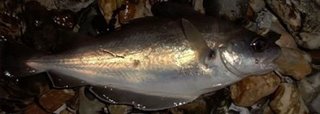
    <- Pout Fish
    .
    .
    .
    .. The blood protein originally used in the research comes from the eel-like ocean pout fish, (see SEA FISHING for details,) which uses it to survive extreme cold at the bottom of the seas.
    ..The process is used to make ice cream with less fat and fewer calories. In a June 23, 2006 DAILY MAIL article the researchers note that: “The protein has been chemically synthesized and can be grown in vast vats which produce a brownish liquid. This is added to the ice cream and lowers the temperature at which ice crystals form and the shape they take up.”
    .. This Genetic Engineering, (GE,) was highlighted on June 26, 2006 by Alaska Fishermen in their web page Alaska Report. The process has already been approved for use in the United States.
    .. GE Free Main, a website in Maine quotes Friends of the Earth food campaigner Clare Oxborrow who said:
    "At a time when more and more consumers want to choose unadulterated food, it's disappointing to see Unilever investing in this unnecessary development in overly processed food."
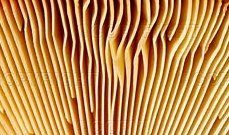
    <- Amanita Gills


    .. This research also found that the process could be used to modify tissue such as gills and blood to become less viscous and more gas permeable.
    .. This result was shown in a series of photos at FishDoc.com in the exploration of bacterial, or environmental gill disease.
    .. The pictures show how gill clumping in cold water fish leads to oxygen deprivation.
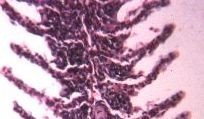
    <- Normal Gill
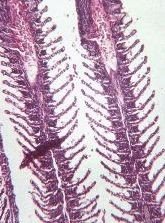


    <- Gill Clumping


    .. The Billings Gazette has just reported on similar research for the production of “Super Trout.” Their article cites research that suggests that if trout are fed creatine, (the same stuff Mark McGwire used,) we could develop super trout with stronger muscles and greater fighting stamina.
    .. Alicia Amyx, part of a family that has operated the Rainbow Trout Ranch fee-fishing operation near Rockbridge, Mo., since 1954, agreed that a new genetically engineered trout could present new possibilities.
    "Fee-fishing operations could market that they had harder-fighting fish, and they could gain some business. I'm sure it would be attractive to some of our fishermen, having harder-fighting trout." she said. "Trout 2 pounds and up fight hard enough. We hear a lot of stories about the one that got away. To have a trout that fought even harder could be exciting."

    .. The United States Trout Farmers Association has already expressed interest in the fish for warm water farming in Georgia and Florida. Hopes are high that a tropical sea-run trout can also be developed.
    .. J. L. Fernandez, et. al. in their article “AluI in situ digestion of human alphoid and classical satellite DNA regions: high-resolution digital image analysis of FISH signals from condensed and extended chromatin.” show the necessary steps for DNA implantation to bring the efficient gills to the trout.
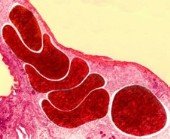

    <- Cell stacking

    .. As shown in the photos, the “clumping,” or “stacking” of trout blood cells reduces their efficiency in carrying dissolved oxygen from the gills to the rest of the organism. The proposed DNA implantation, and the more efficient gills disperse the blood cells and allow for a more efficient gaseous exchange through the more permeable gill membranes. This condition supposedly allows the trout to live in warmer, (less oxygen-rich,) environments.
    .. Another potential use for the DNA modifications is in the treatment of the human condition known as "Rouleaux." Rouleaux is a medical term for a condition wherein the blood cells clump together forming what looks like stacks of coins.
    .. This is an unhealthy state because the cells are not free to absorb and carry oxygen. It is a pre-cursor to many serious diseases, and is associated with ‘stress’ in mammals.
    "Should the calming effects in mammals be observed in trout it is likely that they will rise more freely and take more willingly
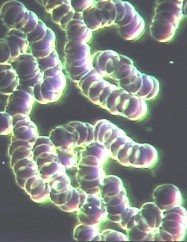
    <- Severe Cell Stacking
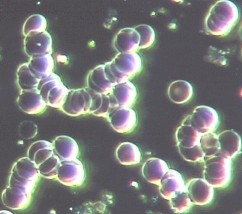


    <- Moderate Cell Stacking


    <- No Cell Stacking


    .. A final result of the applied research comes from The Center for South East Asian Studies, Kyoto University, Kyoto, Japan. In a paper, Y. Yoshida has suggested that there are probably uses for the blood modification in the treatment of MYELODYSPLASTIC SYNROME.
    .. Myelodysplastic syndrome (MDS) is a disease of the blood whose etiology is unclear. The ability to "un-clump" the blood is a major breakthrough!

    --------------------

    .. The first trout to be genetically modified are probably going to be planted in sterile, warm water lakes in the Bechler Region of Yellowstone National Park & in several hot springs along the Firehole River in The Upper Geyser Basin around OLD FAITHFUL.
    .. The probable scientific name of the new GE TROUT has been influenced by the California Golden Trout “Oncorhynchus aguabonita.” and has been informally dubbed "Oncorhynchus geyserensis", (The Geyser Trout.)
    .. Since the brood stock for the genetically engineered experimental fish was the Yellowstone Cutthroat “Oncorhynchus clarki bouveri” it is presumed that the final taxonomic nomenenclature will be: “Oncorhynchus geyserensis yellowstonii,” in honor of the first experimental population in the wild. A revised partial species list for North American salmonid taxonomic data can be found HERE.

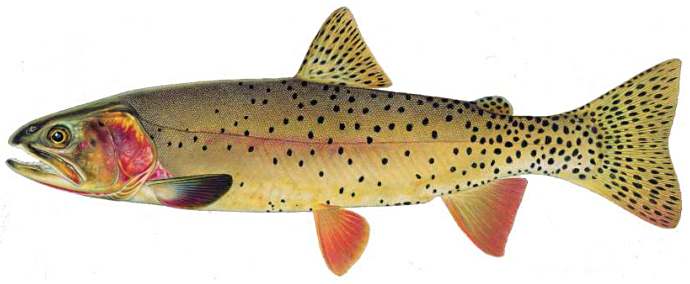
    A picture of the new trout is shown below.


    Really?????

    Sunday, April 01, 2007

    Death Of A Blog

    WHEREIN THE FOUL HAVE FALTERED
    Last Post Smells Like Daisies - Appropriate!
    such is the life of filthy lucre
    this is no april fool

    <span class=


    gotcha

    REALLY ?