• PARTNER: PROTECT YOUR WATERS
  • Go To: THE FLIES OF YELLOWSTONE
  • Go To: YELLOWSTONE FISHING WEATHER
  • Go To: YELLOWSTONE FLY FISHING MAPS
  • Visit: Moldy Chum
  • Visit: The Horse's Mouth
  • Visit: Chi Wulff
  • Visit: Parks' Fly Shop
  • Tuesday, June 06, 2006

    YELLOWSTONE HATCHES

    WHAT IS THAT BUG ?
    When Is That Bug ?
    what's its first name ?


    -- As the season in Yellowstone National Park gets rolling, and more rivers and lakes open up, it's nice to know what the trout are likely to be eating. Hatch charts are one way to help in plannig a trip, or planning what patterns to tie for your visit.
    -- At best the charts are indicative; at worst they are entertaining. There is no substitute for on-the-ground information, (check the sidebar for links.)
    -- The standard reference is "Fishing Yellowstone hatches" by John Juracek & Craig Mathews. This is no 'coffee table' prize. This is an excellent reference that will be worn out if you fish the area regularly.
    -- There are some excellent on-line sources as well. We've listed them below so that you can visit and bookmark them. Like all things fishy, they are weather and condition dependent. Pay no money & take your choice, all will provide insight for your fishing delight.

    Bud Lily's Hatch Chart
    Madison River Outfitter's Hatch Chart
    Total Yellowstone Hatch Chart
    Dan Bailey' Hatch Chart
    Jackson Hole Trout School Hatch & River Chart
    Angelfire Hatch Charts
    Trout Wrangler's Hatch Chart

    The Fly Fishing Report Hatch Chart
    Upper Valley Free Press General Hatch Chart

    -- These will get you started in your planning and fly tying. There is no substitute for on-site information, & you can find that at local trout shops when you reach Yellowstone.

    Monday, June 05, 2006

    FIREHOLE CANYON - HOT

    THEY'RE HEEERE !!
    Madison Sprouts Big Bugs Too
    early PMD's getting better

    <-- Jason Neuswanger Photo
    The Trout Nut


    -- As early as it is, the Stoneflies have arrived. The weather has been cooperative, (just a few snow flurries over the weekend,) and the forecast is for rapid warming into the mid-70's with afternoon thunderstorms.
    -- The one certain way to tell that the rivers on the west side of Yellowstone National Park are fishing well is when the feather merchants are on the banks. No names please, but most of the fly shop operators and their guides were in the park over the weekend. A couple of celebrated writers and fishing personalities were seen too.
    -- Early in the day - about 8:30 AM - (that's 2 hours after sun-up,) the PMD's are breaking the water. Some sections of the Firehole looked like the top of a popcorn popper on Sunday. There are a lot of small fish, (6" - 10",) and it looks like recruitment has been good during the last couple of years. The PMD's are about a size 16, and the fish will take a floating Hare's Ear Nymph, a sunken Yellowstone Badger, or a Pheasant Tail Nymph. Purists can select their favorite dry, they are all working right now. I saw fish to 18" taken on dry flies, and not just a couple. This is big for the Firehole River. The early morning clouds seem to help the hatch along, & should persist for the whole week.
    -- There is no best spot right now; however, the Midway Geyser Basin riffles are producing the densest hatches. The runs below the iron bridge are also producing hatches that twinkle in the low light of morning. Even the quicksand sections around Ojo Caliente and Pocket Basin had good flights of PMD's.
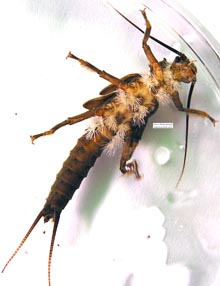
    -- The Salmonflies are just appearing at the water's edge in Firehole Canyon, and it looks like they are out on the Gibbon River and the Madison River as well. The fish are still taking big-black-hairy nymphs, but this will change by tomorrow or the next day. Then you can use Marcella's Trout Fly, or a Sofa Pillow, or just about any other big floater.
    -- There are sparse hatches of Baetis during mid-day, and they are thickest around Mule Shoe and Mattie's Pool. These should get better during the week and should appear very predictably at about 1:30 - 2:00 PM.
    -- The evening Caddis hatch is as regular as ever, but there are a couple of different flies hatching. In practical terms: -the little black ones & the medium-sized brown ones. In technical terms: the little one, (18 -22,) is probably Glossosoma, and the larger one, (12 - 16,) is probably Brachycentrus. These hatches are just getting started, and it's too early to predict if they will be "gobblers" as the locals like to call them.
    -- Hint for the middle of the week: try a riffle hitch on your Sofa Pillow.

    Sunday, June 04, 2006

    Fly Fishing Dangers

    BISON, LIGHTNING, DEEP POOLS
    Watch Yourself
    P.S. - use ratty flies


    <-- Island Park News Photo


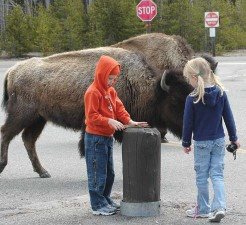
    -- There are dangers everywhere in Yellowstone National Park, & fly fishing brings visitors in contact with most of them. Normal dangers such as being run over by a car are always possible; especially with the visitation increasing.
    -- Obvious dangers such as "habituated" wildlife are everywhere. Even bears and coyotes, and wolves are becoming habituated. These are things to keep in mind while fishing.
    -- Other less common, but real dangers also exist. Sudden weather changes and the frequent thunderstorms pose a real danger. The disturbing thing about inclement weather is that fly fisherfolk know the danger, but the fishing is often "SOO GOOD!" And, it's often true that Baetis, and frequently Caddis pick grungy weather to erupt from the deep. But keep in mind that the current crop of graphite wands are probably better suited to be lightening rods!
    -- Recently a fly fisherman was literally blown out of his shoes and severely injured by lightening. You can read about it in MainToday.com, and wonder that he's still alive. Another fly fisherman drowned in "Junction Pool" where the Beaverkill and Willowemoc come together. This famous pool was well known to the fisherman, as well as most serious fly fisherfolk. You can read about it HERE.


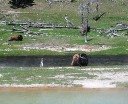
    <-- Bison Guarding PMD Pool on the Firehole.


    -- There are things to think about in Yellowstone that don't exist elsewhere. In addition to wildlife, automobiles, deep pools, thunderstorms, and back casting into traffic; there is the distinct possibility of dying in a hot spring, and being blinded by sulfurous eruptions.
    -- Then there is the quicksand in places like Buffalo Ford, the confluence of the Firehole & Nez Perce, or the submerged hot springs in Pocket Basin.
    -- Of course, typical hazards, such as the abrupt bench at 9-mile hole on the Madison, should also be mentioned. But then if you get in that far - you're wading where you should be fishing! This is often the case in the rivers and streams of Yellowstone. Much of the best holding water, & the best feeding lanes are in the shallow - sheltered bits of water near deep runs and pools. Often visitors walk right into a pile of fish and never know it.
    -- In geological terms, these are young rivers, (some occupy ancestral channels - but still young,) and they exist in boisterous river beds. The gravels and boulders have not had time to be sorted into a uniform substrate. This provides diverse habitats and excellent fish production. It also provides surprises.


    ************************************

    -- On a lighter note; there is merit in fishing "ratty" flies. A recent reprint in Mid Current, of an 'American Angler' article is a must read. Paul Schullery notes in the piece, that:
    " The Magic of Ratty Flies
    As something of a relief to novice fly tiers, ratty flies do work. It's not until we become accomplished at wrapping feathers and fur around hooks that we realize our ever-growing commitment to immaculate ties isn't necessarily helping us catching more fish. In fact, at least in the case of trout flies, it might even hurt our cause (emphasis - mine). On MidCurrent this week Paul Schullery shares his and other well-known authors' wisdom on the subject of less-than-impeccable flies. As he suggests in "The Mystery of the Ratty Fly," embracing the rat might be the smartest thing you do this season."

    -- Now it makes sense!
    -- I don't catch fish because my flies are too good!!

    Saturday, June 03, 2006

    Firehole River & More

    FIREHOLE: PMD's, Baetis, Caddis;
    Gibbon Is Fishable With Big Bugs;
    Nez Perce Creek Too,

    anticipation begins!

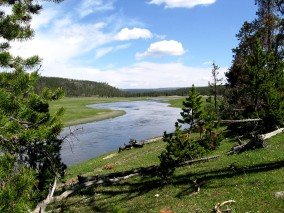
    -- The Firehole River in Yellowstone National Park is living up to its reputation.

    <-- photo courtesy Jason Neuswanger,
    THE TROUT NUT

    -- PMD's were finishing up when we arrived at 2:00 PM, and then the clouds rolled in with a bit of wind. A brief time was spent with some Montana Dusters and some Yellowstone Winter Grubs and then the Baetis started to hatch along with some early caddis - the birds found them too.
    -- We fished around the Nez Perce Creek confluence, and took some very nice fish to 14" with dry flies, along with many very precocious small fish. "The Bite" is still on, and both the bugs and the fish are very cooperative.
    -- A few bison were parked in the adjacent meadows, and navigation was a prime concern as we wandered the bank. Fishing was mostly relaxed and conversational as we chatted with the neighbors, and a couple of visitors.
    -- There was no anxiety about catching, and we probed both the banks and the feeding seams. As the thin Baetis hatch petered out we went back to nymphs, and discussed the possibilities of visiting the Gibbon River.
    -- We piled in the car and headed down to the confluence area at National Park Meadows, and surveyed the lower Gibbon River as we watched some eagles overhead. The river is back within it's banks, the meadows are drying out, and we decided to try the "old burned out picnic area" just below Gibbon Falls.
    -- Around the corner, up the road, and then, try to find a safe place to park. The spoil pile from the road construction is huge, and has raised the area 5 - 10 feet. The picnic area is no longer with us.
    -- There were birds fluttering around but no apparent hatches. We searched with Royal Humpy's and Montana Dusters, then switched to the Winter Grub, and had success with a couple of nice Rainbows. It finally sunk in! There were big bugs in the water.
    -- With the early warming, and the high water moving the bottom around, and the quick recession, and the long photo period --- --- Salmon Fly Nymphs were in the mix. The upper meadows will have to wait!

    -- We dragged out our experiments from the winter and tossed them in the water, (attached to a tippet - of course,) and the frenzy was on!
    -- Cast to the riffles, cast to the pools, cast to the pockets, cast to the runs, probe the banks, drift the seams, -- it did not seem to matter. There were fish everywhere.
    -- We look for the hatch to begin early Monday or Tuesday, or toward mid-week, (or later if the weather turns cold quickly.) There are groceries in the water, and the fish have started to gather them in. As soon as the bugs start to crawl toward the banks the Gibbon River will come alive with fish.


    -- We expect, (unfounded angler wish,) that the Firehole Canyon, and the stretch below the falls has the same thing going on. We'll find out this afternoon or Sunday.

    -- All the flies shown here took fish, (with mashed down barbs,) they have no names, some are two-off experiments. We hope to get back during the week to chase the fish, if not, there is still today and tomorrow.


    Probably no posting for a couple of days. Priorities, -- don'tchaknow!

    Friday, June 02, 2006

    THE FIREHOLE RIVER BECKONS

    GONE FISHING !!
    The River Is Clear,
    The Sky Is Blue,
    Time For A Mental Health Day.


    -- No time for a regular post. The Firehole River In Yellowstone National Park is fishing as good as it has in the last 10 years. On top, in the film, underneath, and spiders dancing upon the water - all attract fish. It doesn't get any better than this. Now is the time to introduce a novice to rapid-fire, no-holds-barred, "CATCHING" - it aint fishing right now.
    -- The rapid warm-up this year, followed by a cool spell has cleared, then lowered the rivers to perfect condition in near record time. The purging still continues below Hebgan Dam. and the main Madison is approaching seasonal flows at Kirby Ranch below the confluence with the West Fork Of The Madison River.
    -- This is the time for the "gentleman's hatch." The bugs should start to flutter about 1:00 PM and continue for 8 or 9 hours. They will still be frolicking when the sun sets. There will be the Mayflies, and the dependable Caddis. Even the bright sunshine can't deter this kind of hatch.
    -- A full report will follow.

    RIVER LEVELS:

    Firehole
    Madison, near West Yellowstone
    Madison, below Hebgan Dam
    Madison, near Camron, Montana

    Thursday, June 01, 2006

    YELLOWSTONE RIVERS - SWEET !

    FIREHOLE RIVER AT 400
    Madison River At 700
    Gibbon River Clearing


    -- The cool weather of the last week has been a boon to early season fisherfolks on the west side of Yellowstone National Park. The three major destinations have come into shape rapidly, and all are fishing very well. It seems that the old fishwife's tale about fishing really starting in June is accurate this year.
    -- Hatches of Mayflies continue on the Firehole, and seem to be getting better - what do those bugs know? There are now some hatches on the Madison, and both Baetis imitations and PMD's are productive. The fish are still hungry, and not very selective yet, so the patterns are not too critical. Size is a bit more important, and a proper drift is still mandatory. Just about any pattern in sizes 14 - 20 is doing fine, and both nymph and streamer fishing can be productive as well.
    -- The Gibbon River has cleared in a remarkably rapid time and fish are available in those sections that can be reached through the flooded meadows. Some midges have been observed, and the fish respond well to streamers.
    -- The fly shown above is the "Quick - n - Easy." It is an old fly, reminiscent of the wet flies of yore. In the water, it becomes a small streamer and resembles not a thing in nature. It is effective this time of year when fished in the undercut banks, and the rapid portions of tailouts.
    -- This fly is a local favorite in Southeastern Idaho for places like the South Fork of the Snake, and some of the smaller streams in that region such as Middle Creek, near Pengree. It has been used as a searching fly on the Gibbon and Madison for about a decade or so and works just dandy.
    -- Like so many flies, it is simple and effective. One kind of feather, one color thread, two colors of floss - done. Before, between, or during technical hatch fishing, this fly will work. It seems to take the eager little fish, or the giants in waiting.

    Recipe for QUICK-N-EASY
    Tail: paired hen hackle, Body: orange floss, Rib: yellow floss, Wing: paired hen hackle, Hackle: hen hackle, Head: yellow or orange thread. (not too small,) Hook: size 4 - 12, heavy nymph - or up to 2xl streamer. Drift the fly with short smooth stripping motion in deep undercuts, or on the swing through the tail of swift pools.

    Wednesday, May 31, 2006

    FIREHOLE RIVER IN GOOD SHAPE

    YELLOWSTONE FISHING GETTING BETTER
    Madison River Clearing Too
    gibbon by the weekend


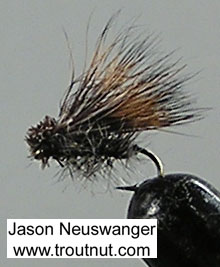
    <-- Deer Hair Caddis

    photo courtesy of
    Jason Neuswanger:
    The Trout Nut


    -- The evening hatches along the Firehole River produce a constant, sometimes sparse, hatch of caddis. These flies are frequently small dark flies with gray to charcoal colored wings. The normal caddis flies work fine for this evening festival, however the fly shown here is an exceptionally good rendition.
    -- Rather than the standard Elk Hair Caddis, use Deer Hair, and a dark body with dark hackle. Visit The Trout Nut for details about this pattern.
    -- During mid-day, (about 11:00 AM if the sun is shining,) the regular Baetis hatch is underway. These are on the smallish side, (about sizes 18 - 20 - 22,) and occur in the smoother pools. Often times a PMD hatch happens at the same time and the fish can be selective - watch carefully. The PMD's are just a bit larger, (about sizes 12 -14 -16,) and found in the heads and tails of swifter pools. When both are happening, the fish will sometimes take nymphs that are floated instead of sunken. This is a good time to use your cripple imitations.
    -- The Madison River has a substantial number of Whitefish this year, and they are fairly large. They are rising freely right now, and are very entertaining in the quick high water. The Madison River has slowed down to a stately 900 cfs, or so in the park, and is clearing rapidly - thanks to the recent cooling trend. The river purging below Hebgan Dam brought discharge to above 2,000 cfs for a short time, but will be slowing today or tomorrow.
    -- The fish in the upper meadow section of the Gibbon River have had to abandon their grazing in the grass, as the river there has returned to it's channel. Negotiation of the wet meadows can be tricky because of their soft nature, and the two grizzly bears near the Norris campground. The Elk meadows stretch looked fishable, but hard work. The canyon sections of the Gibbon are down to the banks, but still a bit off color. These should shape up by the middle to end of next week.